Can you upgrade an electrical panel yourself? Legally, in Colorado — often yes. The state allows a homeowner to pull an electrical permit and do their own wiring on a home they own and live in, inspected to the same standard as a contractor’s work. But a panel upgrade isn’t a wiring project. It’s a service change: a utility disconnect, a load calculation, live service conductors no breaker in your house can shut off, and an inspection your power company waits on before turning you back on. Most homeowners who research what the job actually involves hire it out. Here’s both paths, honestly.
If you’re asking this question, you’re probably not reckless. You’ve swapped outlets, maybe run a circuit, watched enough panel-swap videos to know what’s behind the cover — and you’ve seen the quotes: $2,800 to $4,500 for a 200-amp panel upgrade in Northern Colorado, against maybe $1,000 in parts.
So here’s the honest version, from a shop that has done close to 2,000 panel upgrades across Fort Collins, Loveland, Greeley, and the rest of NoCo. Colorado law is more permissive than most people think. The job is also more involved than most videos show. Both things are true.
What does Colorado law actually allow homeowners to do?
Colorado is one of the friendlier states for DIY electrical work. If you own a single-family home and you live in it, you can pull a homeowner electrical permit and do your own wiring — including, on paper, a panel replacement. The inspector holds your work to the same National Electrical Code standard as any licensed contractor’s. Pass the inspection and the work is legal, insurable, and yours.
Three conditions matter:
- You must own and occupy the home. Rentals, flips, and houses you’re fixing up to sell don’t qualify. That work requires a licensed electrician.
- A permit is required, full stop. Colorado law requires an electrical permit for any work involving the electrical service — panel upgrades, panel replacements, and service changes. Skipping the permit doesn’t make the work DIY-friendly; it makes it unpermitted, which surfaces later at refinance, sale, or an insurance claim.
- Who issues the permit depends on your address. Fort Collins and Loveland run their own building departments. Unincorporated Larimer County has its own electrical permitting portal. Inside Estes Park town limits, permits route to the Colorado State Electrical Board. Getting this wrong costs you a week before you’ve touched a wire.
Worth knowing: no Colorado law forces you to replace a Federal Pacific, Zinsco, or Challenger panel. That pressure comes from insurance carriers, not the code — and carriers across Northern Colorado now flag those brands at renewal with a deadline, not a suggestion.
So the legal answer is yes, often. Now the practical one.
What does a panel upgrade actually involve?
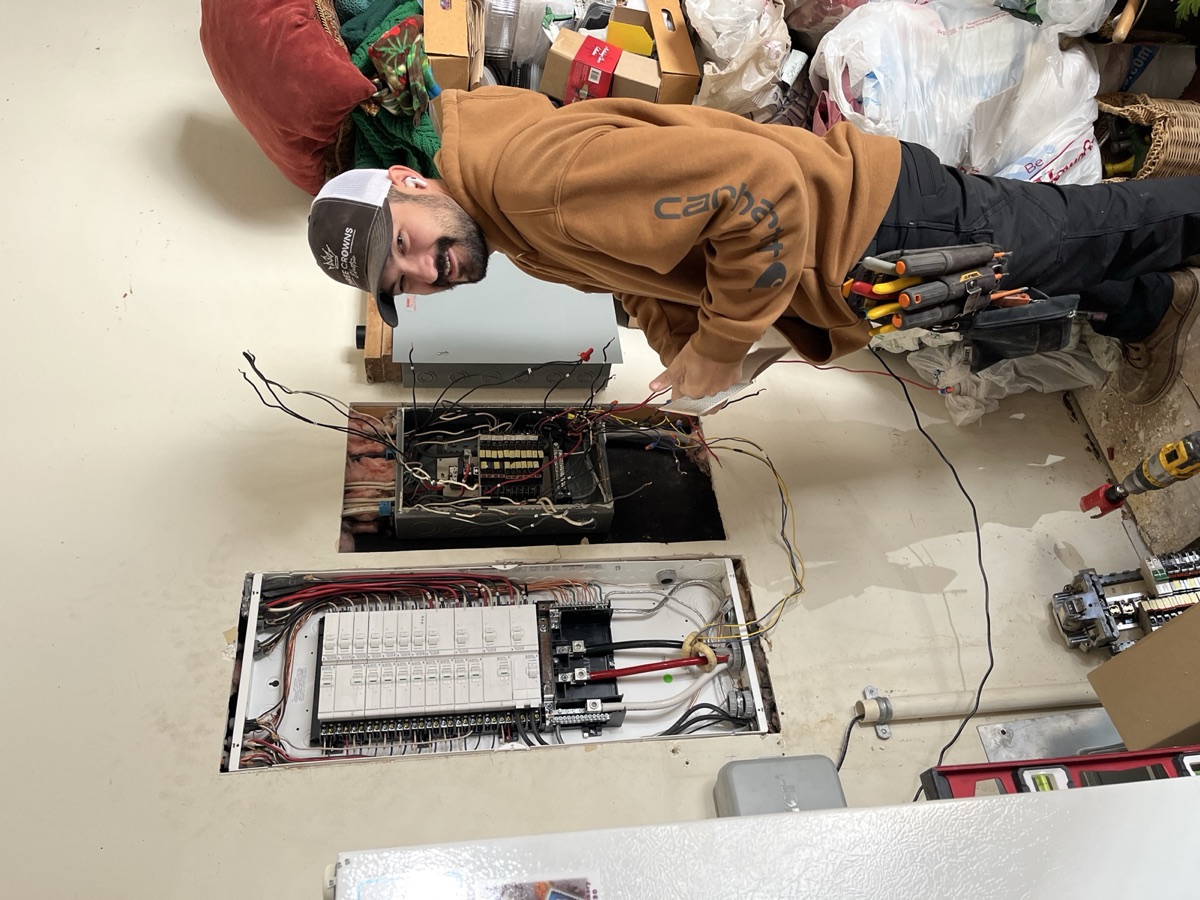
A panel swap looks like an afternoon of screwdriver work in the videos. Here’s the actual sequence on a Northern Colorado job:
- Load calculation. Before anything gets ordered, you calculate what the house draws now and what it will draw with whatever you’re planning — EV charger, hot tub, electric cooktop. The NEC has specific calculation methods, and the inspector will want to see the math. If you want to understand your starting point, learn to read your electrical panel first.
- Permit and one-line drawing. A service-change permit typically wants a drawing showing service size, conductor sizes, and grounding. This is where a lot of homeowner applications stall.
- Utility disconnect. The power company kills power at the meter or the drop so the panel can be worked dead. You schedule this; they show up on their timeline, not yours.
- The swap itself. Old panel out, new panel and breakers in, every circuit re-landed and torqued to spec, grounding and bonding brought to current code. If the meter base is degraded — common on 1970s houses — it gets replaced too.
- Code-current protection. That means AFCI and GFCI breakers on most circuits and whole-home surge protection on new services. Not optional line items; the inspector checks.
- Inspection, then reconnection. The inspector signs off, and only then does the utility re-energize.
Jon Trujillo has run this sequence close to 2,000 times. Here’s how he describes the part homeowners don’t see:
“Anytime there’s an upgrade, we got to coordinate with the local utility provider as well with the local building department. So we do pull permits to schedule with the utility provider. Utility providers don’t energize our new service until we do have permits and inspections taken care of.”
— Jon Trujillo, Master Electrician
None of these steps is impossible for a capable homeowner. The problem is that two of them can’t be done by you at all, and one of them can kill you.
The part that gets people hurt: the line side is always hot
Flip your main breaker off and every circuit in the house goes dead. Feels safe. It isn’t — not where you’re about to work.
The main breaker shuts off the load side of your panel. The service conductors feeding the top of that breaker — the line side — stay energized. There is no switch in your house that turns them off. The only overcurrent protection upstream of those lugs is the utility transformer, which is built to feed your whole street.
That matters for one specific reason: if a tool, a wire strand, or your hand faults those conductors, no breaker trips. The fault arcs and dumps energy until something burns away. Electricians call this arc flash, and it’s why a panel swap is done with the meter pulled — the service fully dead — or by people trained and equipped to work it hot. A homeowner replacing a panel with only the main off is doing live-bus work whether they realize it or not.
And no, you can’t just pull the meter yourself. The meter belongs to the utility, and cutting the seal is tampering. The disconnect goes through them.
The utility problem nobody warns you about
Say you do everything right: homeowner permit approved, panel swapped cleanly, inspection scheduled. You are now waiting on two organizations whose calendars you don’t control — the building department and your power company.
Here’s the part we know from doing this every week: no Northern Colorado utility publishes reconnect lead times for residential service changes. Not Xcel. Not Poudre Valley REA. Not Loveland Water and Power or Longmont Power. The sequencing between inspector sign-off and reconnection is contractor knowledge, learned by working with these offices constantly. A shop that does panels weekly times the cut-in so the power is off four to six hours on one day. A first-timer who books the disconnect before the inspection slot is confirmed can be running extension cords from the neighbor’s garage for days.
That’s not a scare story. It’s a scheduling reality, and it’s the most common way DIY panel jobs go sideways even when the wiring is fine.
Is the inspection hard to pass in Northern Colorado?
The inspection is real. Jon’s experience with NoCo inspectors:
“They’re all really well trained. Most of them are already journeyman electricians, if not have gone through intensive training on what they are looking at when it comes to service upgrades.”
— Jon Trujillo, Master Electrician
An inspector who spent years in the trade will check torque on lugs, conductor sizing, grounding and bonding, AFCI/GFCI coverage, working clearance, and panel labeling. A failed inspection means corrections, sometimes a re-inspection fee, and more days without a signed-off service. That’s a feature, not an obstacle — as one commenter on a panel-replacement thread put it, electrical codes are written in the blood of people who burned in house fires.
What can you safely do yourself?
Plenty. The honest answer to “can I do my own electrical work” isn’t “never” — it’s “match the job to the risk.”
Genuinely homeowner-appropriate work, done with the circuit shut off and verified dead with a tester:
- Replacing receptacles and switches like-for-like
- Swapping light fixtures and ceiling fans (on a fan-rated box)
- Replacing a thermostat on a dead circuit
- Mapping and labeling your panel so you actually know what each breaker feeds
Like-for-like device swaps generally don’t require a permit. The line moves when you add a circuit, extend wiring, or touch anything in or upstream of the panel — that’s permit territory, and in an owner-occupied Colorado home you’re allowed to pull that permit yourself.
One rung up sits breaker replacement: simple work, but it means opening a live panel, which changes the risk entirely. We covered that decision in do I need an electrician to replace a circuit breaker.
A homeowner on a panel-upgrade forum summed up the sane version of DIY better than we could: “I educate myself to the point I feel I can do it, then I call in an expert. At least then I know if he is ripping me off.” That’s not surrender. That’s knowing your limitations and using the research as leverage.
What does a licensed electrician’s price actually buy?
A 200-amp panel upgrade in Northern Colorado runs $2,800–$4,500. Here’s the same job, both paths:
| What the job requires | DIY (homeowner permit) | Licensed electrician |
|---|---|---|
| Panel, breakers, materials | $600–$1,200 out of pocket | Included in quote |
| AFCI/GFCI breakers (code-required) | $200–$400 more than standard breakers | Included in quote |
| Load calculation + one-line drawing | You produce it; inspector checks it | Done before the quote |
| Permit + utility coordination | You schedule both; no published lead times | $150–$300, handled — cut-in timed to one day |
| The swap | Live line-side lugs unless the meter is pulled | Worked dead or by trained hands |
| Power outage window | Days if the sequencing slips | Typically 4–6 hours, one day |
| Inspection | Same standard; corrections on your time | Corrections are the electrician’s problem |
| If something fails in a year | On you | On the shop that did it |
The gap between the $1,000-ish parts bill and the $2,800–$4,500 quote isn’t markup on a box of breakers. It’s the load calc, the utility relationship, the inspection passing the first time, the outage measured in hours instead of days, and someone else owning the result. The full price breakdown is in our Colorado panel cost guide.
One more thing that quote buys at Three Crowns specifically: our technicians are salaried, not commission-based. Nobody’s pay depends on talking you into a bigger job. The load calculation decides what you need — sometimes the answer is that your existing panel is fine and you don’t need us at all.
When to call a licensed electrician
Call rather than DIY if any of these apply:
- The job touches the service — panel replacement, meter base, service upgrade. The line side and the utility coordination put this past the sensible DIY line even where it’s legal.
- Your panel is a Federal Pacific, Zinsco, or Challenger. These brands have documented failure modes. Jon has tested them personally:
“I’ve held wiring trying to short them out before and it’ll literally just start welding. So they are not, they do not trip out like the new design breakers do if there’s a fault in your wiring.”
— Jon Trujillo, Master Electrician
- The house isn’t owner-occupied. Rentals and flips legally require a licensed electrician in Colorado.
- You’re seeing symptoms, not planning a project — breakers keep popping, lights dim when the AC kicks on, warm panel cover, burning smell. That’s diagnosis, not installation. Check the signs your panel needs replacing.
- Insurance gave you a deadline. A 30-day non-renewal letter is not the moment to learn service work.
If you’re weighing it, a panel upgrade from Three Crowns Electric starts with a free on-site visit: amperage reading, load calculation, and a price on paper before anyone touches a wire. Call (970) 460-0014. If the numbers say you don’t need the upgrade, we’ll tell you that too.
Frequently asked questions
Do I need a permit to replace an electrical panel in Colorado?
Yes. Colorado law requires an electrical permit for any work involving the electrical service — panel upgrades, panel replacements, and service changes — whether a contractor does the work or you do. The permit routes through your city building department in Fort Collins and Loveland, Larimer County for unincorporated addresses, and the State Electrical Board in some areas.
Can a homeowner legally pull their own electrical permit in Colorado?
Yes, for a single-family home you own and occupy. You apply for the homeowner permit, do the work yourself, and pass the same inspection a contractor’s work would face. The exemption doesn’t cover rentals or homes you’re renovating to sell — those require a licensed electrician.
Can I replace my breaker box myself if I’m not changing the amperage?
A like-for-like panel swap is still a service change. The conductors feeding your main breaker stay live unless the utility disconnects them, the job still requires a permit and inspection, and the utility still won’t re-energize until the inspection passes. Same amperage just means you skip the load-calculation debate.
Is it illegal to pull your own electric meter?
Don’t. The meter is utility property, and cutting the tamper seal to pull it yourself is treated as meter tampering by Xcel, Poudre Valley REA, and every other Colorado utility. The disconnect gets scheduled through the utility as part of the permitted job.
Will an unpermitted panel upgrade cause problems later?
Usually, yes — just not immediately. Unpermitted service work surfaces at the worst times: a home sale inspection, an insurance claim after a fire or surge, a refinance appraisal. The common outcome is paying a licensed electrician to open up, correct, and re-permit work that already got paid for once.
Last reviewed by a licensed Master Electrician: August 2026