





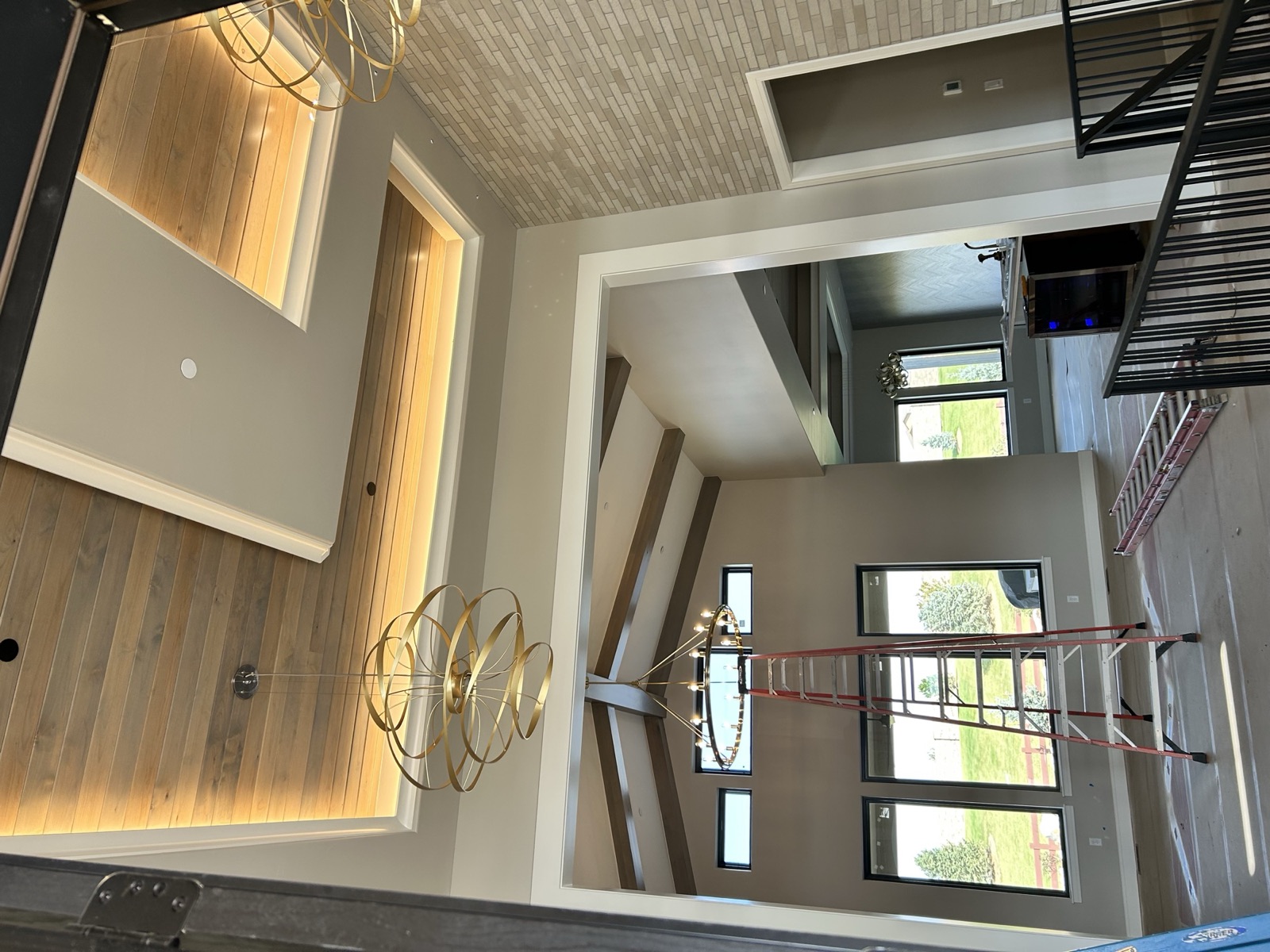
Professional lighting installation in Northern Colorado runs $200–$3,000 per project (median ~$900) — recessed retrofits, pendants, chandeliers, ceiling fans, landscape, and under-cabinet. Recessed cans installed in finished ceilings are $200–$300 per fixture; a typical kitchen retrofit of 6–8 cans runs $1,200–$2,000 including fixtures, switching, and dimmers. We install customer-supplied fixtures, run new wire if no existing wiring, and aim landscape systems at night so you see what you’re paying for. Three Crowns is in the Fort Collins Local Pack at rank #2 for lighting installation.
Lighting is the cheapest upgrade that actually changes how a house feels. A kitchen with the right recessed layout, a dining room with a pendant hung at the right height, a back patio with path lights aimed at the steps you actually use at night — all of it is electrical work done right the first time, with the fixtures centered and the switches where you reach for them.
We do recessed retrofits, pendants, chandeliers, ceiling fans, under-cabinet, vanity, track lighting, landscape, and full outdoor low-voltage. About 30% of our lighting jobs are kitchen recessed retrofits in finished ceilings — that’s the work most other electricians try to avoid because of the drywall patching, and it’s the work we’ve gotten genuinely good at over 20 years in the trade.
How much does it cost to install lighting in Northern Colorado?
Lighting projects scale with the number of fixtures, the ceiling type (finished vs unfinished), and whether new wiring needs to be run. Most projects fall in this range:
| Project type | Typical cost | Notes |
|---|---|---|
| Single fixture swap (existing wiring, accessible box) | $200–$350 | Pendant, vanity, ceiling light replacement |
| Single fixture install (no existing wiring) | $400–$700 | We run new wire + add a switch |
| Recessed cans, retrofit in finished ceiling | $200–$300 per can | Most common; includes patching |
| Kitchen recessed retrofit (6–8 cans + dimmers) | $1,200–$2,000 | Most common project type |
| Chandelier install in 2-story entry | $400–$1,200 | Plus lift rental cost on tall ceilings |
| Ceiling fan install (existing box) | $250–$450 | Includes fan-rated brace box swap |
| Ceiling fan install (no existing wiring) | $500–$900 | New circuit + switch + brace box |
| Landscape low-voltage system (8–15 fixtures) | $1,500–$3,000 | Path lights + uplights + transformer + night aim |
| Under-cabinet kitchen lighting | $400–$1,200 | Hardwired LED tape, switched to existing |
We don’t quote over the phone for anything beyond a single-fixture swap. The variables matter — ceiling type, fixture weight, wiring access, switch location — and the only honest way to give a real number is to see the actual house.
Recessed lighting installation: $200–$300 per can in finished ceilings
About a third of our work is retrofit recessed lighting — adding cans to a kitchen, dining room, or basement that doesn’t have them yet. Most homeowners assume this means tearing the ceiling apart. It doesn’t. We’ve gotten the patching down to where you can usually only find the cuts if you know exactly where to look.
The process for a typical kitchen retrofit:
- Plan the layout — we map can positions to your counters, island, and work zones (not just an even grid)
- Open small access holes — typically 4–6 small (~3” diameter) cuts in the ceiling for wire fishing, plus the can holes themselves
- Fish the wire through the cuts — we work from below if there’s a finished space above, or from the attic if it’s the top floor
- Cut the cans to the planned positions
- Wire to a dimmer — almost always a dimmer; LED dimmable cans are now the default
- Patch the access holes — drywall, mud, sand, paint to the existing color (we match if you have leftover paint, or recommend a painter for the final coat)
The retrofit pricing assumes finished drywall ceilings (the typical NoCo home). Top-floor retrofits with attic access are slightly cheaper because we don’t have to fish wire through finished space. Vaulted or cathedral ceilings cost more — usually $300–$450 per can — because of the lift work and more complex routing.
For old town Fort Collins or Loveland homes built in the 1940s–1960s, we sometimes find plaster-and-lath ceilings instead of drywall. Those are still doable but cost about 20–30% more in patching labor.
Can you install a ceiling light or fan where there’s no existing wiring?
Yes. This is one of the most common requests we get, and it’s a job that scares off DIY-curious homeowners because the wiring side is what most people don’t want to figure out.
The work involves:
- Trace a viable circuit — we find the nearest existing circuit that has capacity and run a junction box
- Run new wire to the new fixture location — through the wall and across the ceiling, fished from the attic or from below
- Cut the box — fan-rated brace box if it’s a fan; standard if it’s a fixture
- Add a wall switch — typically next to the room’s primary light switch, gang-mounted into the existing switch box
For a single new fixture in a bedroom or living room, the job is typically $400–$700. For a ceiling fan in a master bedroom with no existing fan box (the most common version of this request), the job is $500–$900 because of the brace box and the often higher amperage circuit needed for the fan motor.
The reason a ceiling fan needs a different box: a regular light fixture box is rated for static weight (a typical fixture under 10 lbs) but not for the dynamic load of a fan with motor torque, wobble, and 35–55 lbs of mass. Hanging a fan from a regular box is how fans fall through ceilings. We replace it with a UL-rated fan brace box that spans between two ceiling joists.
Pendants, chandeliers, and high-ceiling installs
Pendants and chandeliers are mostly straightforward — drop the wire, hang the fixture, level it, dim it appropriately. The exception is high-ceiling installs (typical 2-story entries, vaulted dining rooms, open great rooms), which require either a scaffold or a scissor lift to do safely.
For 2-story entry chandeliers (a common request in newer NoCo subdivisions):
- We bring a scissor lift if the ceiling is over 14 feet
- The fixture has to be supported with an appropriate brace if it’s over 35 lbs
- The dimmer rating has to match the fixture’s wattage and bulb type
- The chain or cable length matters — too long looks oversized; too short looks awkward; we hang the fixture so the bottom is roughly 7 feet above floor level for foyers, or about 30 inches above the table top for dining rooms
We charge $400–$1,200 for chandelier installs, depending on weight, height, and lift requirements. Customer-supplied fixtures are fine — we install them all the time and quote labor + accessory parts (brace, dimmer, box) separately from the fixture cost.
Landscape and outdoor low-voltage lighting (we aim it at night)
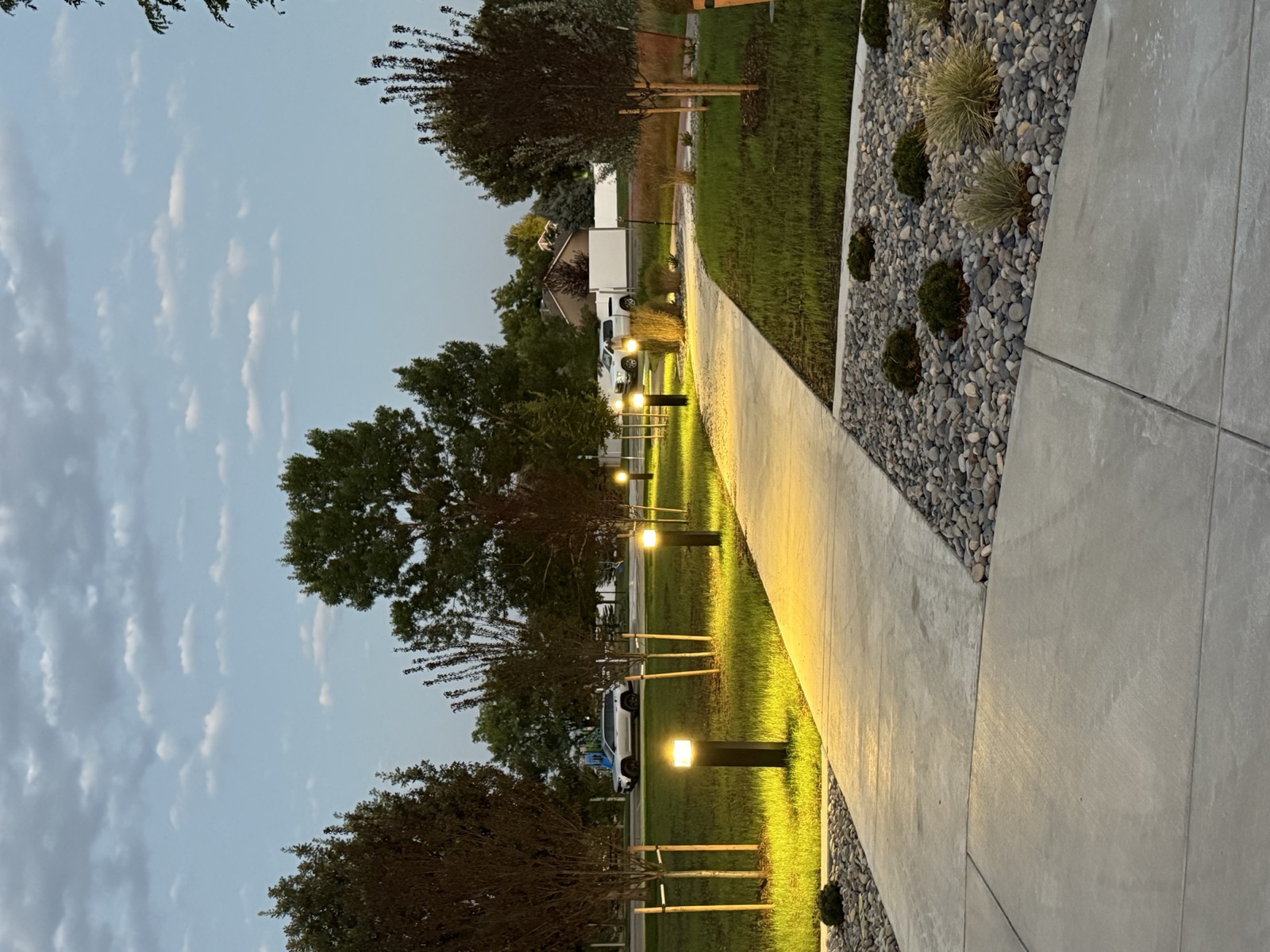
Landscape lighting is one of those projects where the difference between a good job and a great job is entirely in the aiming. We install a lot of NoCo landscape systems and the part most homeowners don’t expect is that we come back at night for the aim. You can’t tell whether an uplight is washing the tree correctly during the day — the light isn’t visible until after dark.
What we install:
- Path lights — typically along walkways, driveways, and garden borders
- Uplighting — on trees (especially aspens, blue spruces, mature deciduous), tall plantings, architectural columns
- Wall washing — accenting building facades, retaining walls, water features
- Downlighting — under eaves to wash down on patio surfaces (the “moonlight” effect)
- Step lights — recessed into deck risers, retaining wall caps, stair stringers
- Soffit lighting — facade detail under eaves
- Bistro string lighting — patio/pergola, hardwired-switched (not just plugged into an outlet)
Typical 8–15 fixture system runs $1,500–$3,000 fully installed including the transformer, buried wire (we use 12-2 direct-burial), the fixtures themselves, and the night aim. We use brass and copper fixtures from manufacturers like FX Luminaire and Kichler that survive the NoCo weather (some of the cheap aluminum landscape fixtures from box stores last 1–2 winters before corroding).
The night aim is included. We come back after dark, walk the system with you, and tweak each fixture’s angle and position until it looks the way you want. About half our customers want adjustments after the first heavy season’s growth, and we include one return visit in the original quote.
Under-cabinet, vanity, and accent lighting
Under-cabinet lighting is the lowest-hassle, highest-impact upgrade in most kitchens. A run of hardwired LED tape under the upper cabinets adds task lighting that the recessed cans above can’t reach. Typical kitchen run is $400–$1,200 depending on cabinet length, switch wiring, and whether we’re cutting in a new switch or tying into an existing one.
We use hardwired (not plug-in) LED tape and a dedicated transformer for two reasons:
- No visible cords — plug-in strips have to plug into an outlet, which means an outlet inside or behind the cabinet (ugly)
- Switched control — hardwired tape ties into a wall switch (or a smart switch), which is cleaner than reaching under the cabinet for a manual button
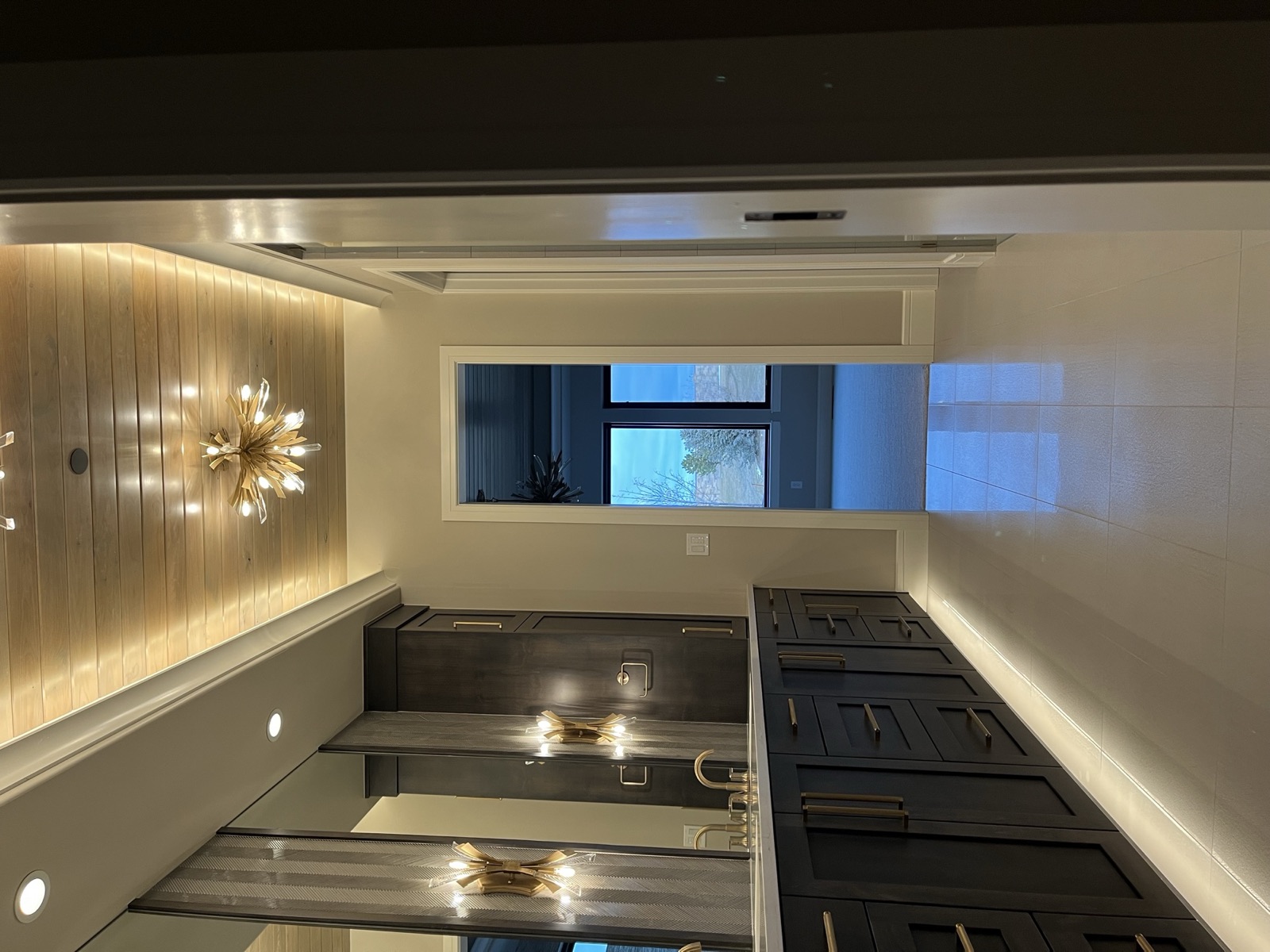
Vanity lighting follows the same logic: hardwired sconces flanking the mirror at face height, on a dimmer, switched at the door. We install vanity fixtures from $300–$700 depending on the fixture and whether we’re adding a new switch.
Accent lighting (cove lighting, toe-kick, stair tread) is custom per project. Quote on the site visit.
Will you install a fixture I bought myself?
Yes — we install customer-supplied fixtures all the time. We quote labor and accessory parts (switches, dimmers, boxes, brace kits) separately from the fixture cost.
The one thing we tell every customer up front: if the fixture shows up broken or is missing parts, we’ll tell you on the truck so you can return it before we open the box and void the return policy. We don’t want to install a damaged fixture and then have you find out two weeks later that you can’t return it. The honest sequence is: open the box together, inspect the fixture, decide whether to proceed or send it back.
For customers who want help picking fixtures, we don’t sell hardware so we don’t push specific brands — but we’ll tell you which ones we’ve installed that have held up well in NoCo.
Smart switches, dimmers, and motion sensors
Smart switches (Lutron Caseta, Kasa, Leviton Decora Smart) are increasingly common in our installs. We do a lot of full-home swap-outs: replace every switch in the house with a smart switch tied to a hub, then control via app or voice. Typical whole-house smart switch upgrade for an average 3-bedroom home is $1,500–$3,000 depending on switch count and whether new wiring or neutral wires are required.
Dimmers are now the default for almost any new lighting install. LED dimmable bulbs and dimmable LED tape have made dimming universal, and the per-switch cost is small ($30–$60 above a standard switch). We dimmer every recessed retrofit, every chandelier, and most pendant installs unless the customer specifically wants a fixed brightness.
Motion sensors are most common in three locations: garages (auto-on when you walk in with groceries), pantries, and outdoor security floods. We use both occupancy sensors (turn off automatically when room is empty) and vacancy sensors (manual on, auto off) depending on the use case.
Last reviewed by a Master Electrician: April 29, 2026.
Have a lighting project in mind? Call (970) 460-0014 for a free estimate. We’ll come look at the space, measure ceilings, plan the layout, and put a written quote on paper before any drywall comes off.