




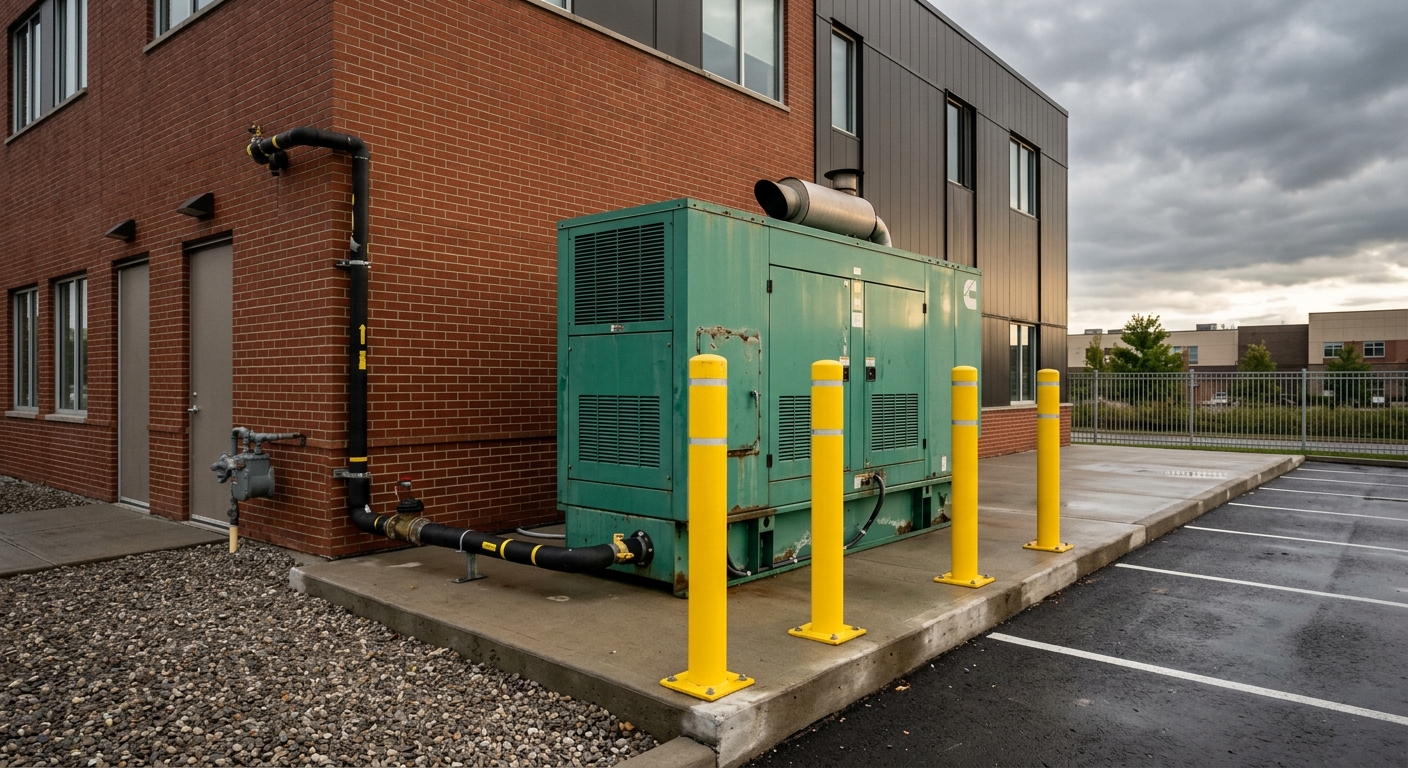

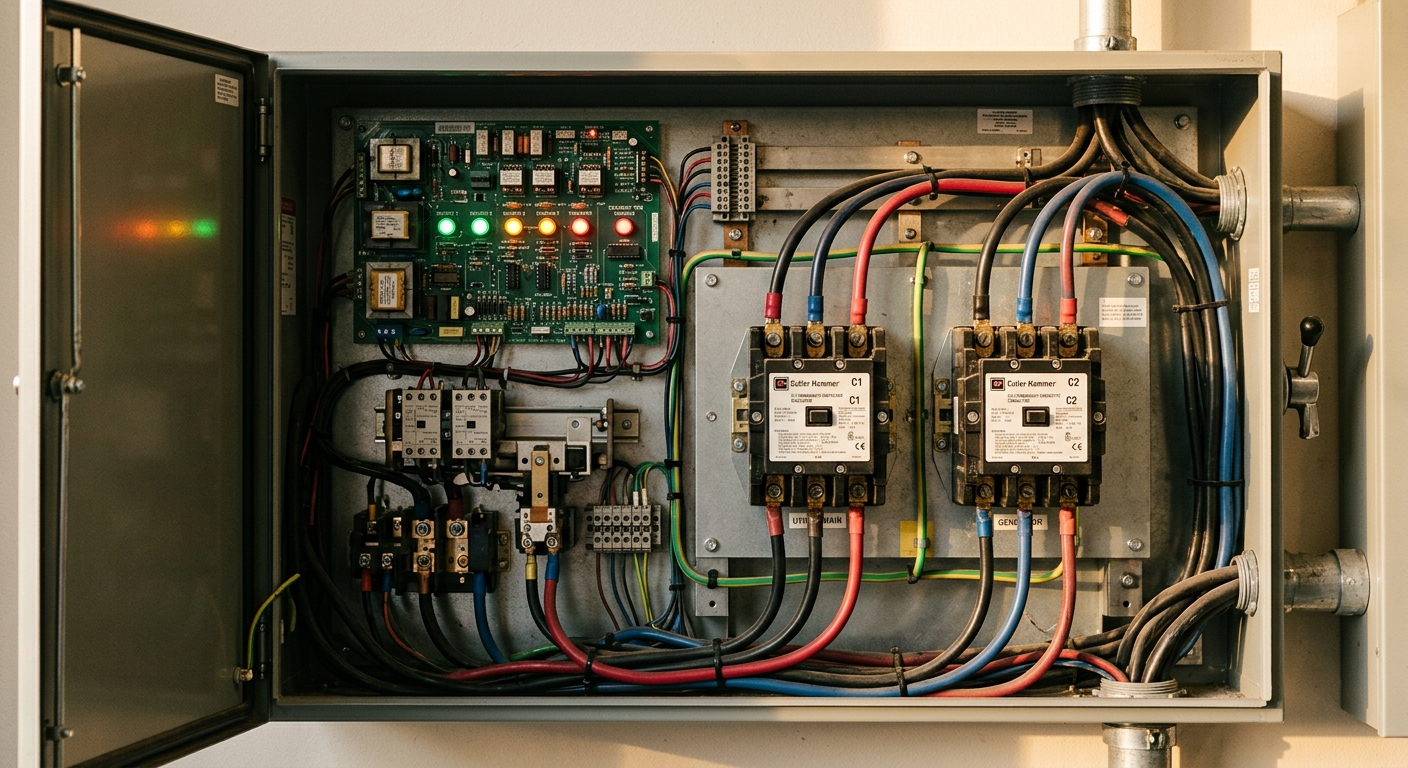
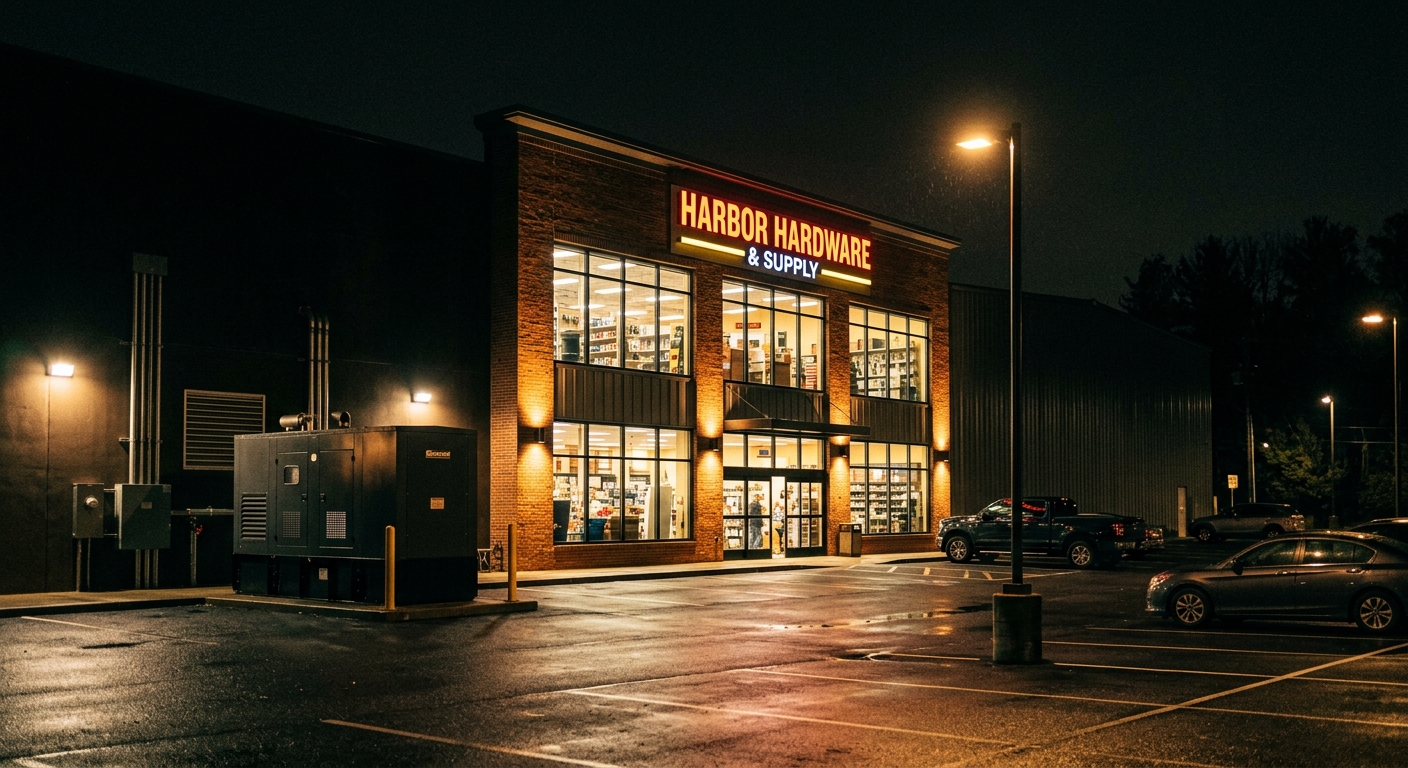
Commercial standby generator installation in Northern Colorado typically runs $10,000–$50,000+ depending on kW size, fuel type, transfer switch complexity, concrete pad work, and enclosure requirements. We install Generac, Kohler, and Cummins commercial standby systems for medical, food service, data, multi-tenant, and mobile home park facilities — anywhere a 4-hour outage is a five-figure problem. Includes automatic transfer switch, load shedding configuration, fire department review coordination, and annual service plans with load bank testing.
A medical clinic with refrigerated medications, a restaurant with walk-in coolers, a data closet that can’t tolerate 30 minutes of downtime, a mobile home park with essential services — these are facilities where a four-hour outage isn’t an inconvenience, it’s a five-figure (sometimes six-figure) problem. A commercial standby generator runs on natural gas or propane, starts automatically when utility power drops, and keeps the operation alive until the grid is back.
We install commercial standby generators across Northern Colorado for medical, food service, IT/data, multi-tenant, and light-industrial facilities. About 30% of our generator volume is commercial; the other 70% is residential whole-home backup. The hardware is similar — the coordination, fire-department review, and ATS sizing are dramatically different.
What size generator does a commercial facility need?
Depends entirely on what has to stay on. The right way to size is a load study, not a guess:
| Facility type | Typical generator size | Critical loads |
|---|---|---|
| Small dental / medical office | 20–35kW | Lights, computers, fridge for medications, HVAC fan |
| Restaurant (full operation) | 60–100kW | Walk-ins, freezer, hood, HVAC, POS, lights |
| Multi-tenant office building | 80–150kW | Egress lighting, elevators, life-safety, common HVAC |
| Light industrial / warehouse | 100–200kW | Production line essential motors, lighting, freight elevator |
| IT / data closet | 20–50kW (often with UPS bridge) | Servers, network, HVAC for closet |
| Mobile home park | 100–200kW | Common pumps, lighting, sewage |
| Multi-family / apartment complex | 80–250kW | Hallway lighting, elevators, life-safety |
We do a commercial load study, identify your critical loads (vs nice-to-have loads), and size to the critical load with appropriate startup margin for motor inrush. The math typically lands at the lower end of the range you’d expect from rule-of-thumb sizing because we don’t oversize for non-critical loads.
How much does a commercial generator cost installed?
A typical commercial standby generator install runs $10,000 to $50,000+. The variables:
| Project profile | Typical cost | Notes |
|---|---|---|
| 20–35kW dental/small office, NG, basic ATS | $10,000–$18,000 | Most common small-commercial |
| 60–100kW restaurant or mid-size | $20,000–$35,000 | Larger fuel line, sound enclosure |
| 100–150kW multi-tenant or light industrial | $30,000–$50,000 | More complex distribution, larger pad |
| 150kW+ critical facility | $45,000–$80,000+ | Sometimes redundant ATS, fuel storage |
The price drivers: kW size, fuel type (natural gas vs propane vs diesel — diesel adds tank costs), automatic transfer switch complexity (single ATS vs multiple priority circuits), concrete pad and gravel pad work, enclosure requirements (sound-attenuated for facilities near residential), fire department review fees, and after-hours commissioning if the facility can’t shut down for testing.
We quote the whole scope — generator, ATS, fuel line, pad, permit, fire-dept review, inspection, and commissioning — as one itemized number.
Natural gas, propane, or diesel?
For most NoCo commercial facilities, natural gas is the answer. The hierarchy:
- Natural gas (preferred) — connected directly to your facility’s gas service, runs indefinitely during a power outage, no refueling, no tank
- Liquid propane — for facilities without natural gas service, or where gas line capacity is insufficient. Requires onsite tank sized to expected runtime (typically 500–1,000 gallons for commercial)
- Diesel — for critical facilities where fuel independence matters (hospitals, data centers, military installations) or facilities that already operate diesel fleets. Requires fuel tank with daily/weekly maintenance and fuel polishing
Natural gas wins for almost every commercial application in NoCo because the gas grid is highly reliable and fuel cost is the lowest of the three options. Diesel makes sense only for genuinely critical facilities that can’t risk natural gas line failure during a major event.
We coordinate with your gas company (Atmos Energy, Black Hills Energy, or Xcel) on gas service capacity. Larger commercial generators (100kW+) often require a gas service upgrade — we file the paperwork and align timing with the install.
Do you handle the permits and inspections?
Yes. Commercial generator installs are more involved than residential — there’s typically four separate sign-offs required:
- Building permit with the local jurisdiction (Fort Collins, Loveland, Windsor, Greeley, Boulder all have separate offices)
- Electrical permit for the ATS install + service upgrades
- Mechanical/gas permit for the fuel line work
- Fire department review for fuel storage, generator location, and life-safety integration
Some jurisdictions also require a noise variance or zoning review for residential-adjacent commercial buildings. We file every piece of paperwork and coordinate the inspection timing so the schedule holds.
Do you do annual service and maintenance?
Yes. Commercial generators need annual service to maintain warranty and ensure they actually start during an outage. Standard annual service:
- Oil change + filter replacement
- Air filter replacement
- Spark plug replacement (gas-fueled units)
- Battery test + replacement if needed
- Coolant level + freeze protection check
- Transfer switch exercise + functional test
- Visual inspection of all wiring and connections
- Generator self-test verification
- Written service report
For larger units (60kW+) or critical facilities, we add load bank testing — running the generator under simulated full load for 1–2 hours to verify it can handle the actual emergency duty cycle. Load bank testing is required by many insurance carriers and by NFPA 110 for life-safety facilities.
We track every commercial generator we install, schedule annual service automatically, and provide a written report after each visit. Most commercial customers don’t have to remember when service is due — we do.
For the residential generator side of this conversation, see our home generators page. The hardware overlaps but the workflow, permitting, and ATS sizing are completely different.
Last reviewed by a Master Electrician: April 29, 2026.
Have a commercial standby generator project? Call (970) 460-0014 for a free site visit and load study. We’ll come walk the facility, identify critical loads, scope the gas service, and put a written quote on paper — including the fire-department review timeline so you know exactly what to expect.