






Most residential electrical repair visits in Northern Colorado run $150–$500 for diagnosis plus a simple fix. We troubleshoot tripping breakers, dead outlets, partial outages, burning smells, flickering lights, and failing GFCIs — every repair starts with a real diagnosis and a written quote, not a sales pitch for a new panel. Electrical repair is 56% of our work and the single biggest reason our 518+ reviewers call. Same-day in most NoCo towns during business hours.
Electrical repair is by far the largest service we run — about 56% of every job that comes through the door is a homeowner with a problem that needs diagnosing. A breaker that won’t hold. A burning smell from an outlet. A fridge, oven, and hallway lights all out at once while the rest of the house works fine. The pattern we see again and again is the same: the homeowner has been told by someone — a neighbor, a Google search, a different electrician — that the answer is a new electrical panel. About 95% of the time, it isn’t.
“Most homeowners will call us due to if they have breakers tripping. Or if they’re concerned about adding new appliances [or] EV chargers.”
— Jon Trujillo, Master Electrician
What follows is what we actually find on those calls, what the visit costs, and the symptom-by-symptom diagnostic logic we use before anyone quotes a fix.
What are the signs you need an electrical repair?
Six symptoms account for the vast majority of our repair calls. If you’re seeing any of these, the wiring or a connection somewhere is telling you it needs attention:
| Symptom | What it usually means | Same-day priority |
|---|---|---|
| Breaker keeps tripping | Short, overload, failing appliance, or loose connection downstream | Standard |
| Burning smell from outlet | Something is overheating — fire risk | Yes — immediate |
| Partial outage (fridge + oven + hallway out) | Lost contact on one of the two 120V legs feeding the panel | Yes — same day |
| Flickering lights | Loose neutral, failing breaker, or utility-side issue | Standard |
| GFCI that won’t reset | Tripped device, wired wrong, or actual ground fault | Standard |
| Dead outlet (kitchen / bathroom) | Failed receptacle, loose wire, or upstream tripped GFCI | Standard |
The reason we treat the burning smell and partial outage as same-day priorities is that both can escalate. A burning smell is an outlet that’s already heating up — give it another week and it can ignite. A partial outage on a fridge circuit means the fridge is now running on a degraded voltage that will kill the compressor. We route those ahead of routine work.
What we don’t treat as a “you need a new panel” call: any of these six symptoms in isolation. The panel might be fine. The wire 30 feet downstream is the problem about 9 times out of 10.
A breaker keeps popping — do I need a new panel?
Usually not. A breaker that won’t hold on is doing its job — it’s telling you something downstream of it is drawing too much current or has a fault. Sometimes that’s a single appliance that’s failing. Sometimes it’s a loose neutral. Sometimes it’s a circuit that was overloaded the day it was wired in 1978 and you just noticed because you added a microwave.
The diagnostic process: we trace the circuit, identify what’s actually pulling current when the breaker pops, and quote the real fix. The fix is rarely “a new panel.”
“We do an amperage reading and check out what their home is drawing for power. And then we kind of let them know where they’re at with their power usage now.”
— Jon Trujillo, Master Electrician
That amperage reading tells us whether the panel itself is undersized for the home (rare — and that’s a real panel upgrade conversation) or whether one specific circuit is past its rated draw (common — and that’s a circuit-level fix).
We don’t sell panels we don’t believe in. If we tell you it’s a panel job, it is. If we tell you it’s a $185 loose neutral, it is. We’ve sent customers home from a “I need a new panel” panic with a 30-minute fix more times than we can count.
The fridge, oven, and hallway lights are out — what is that?
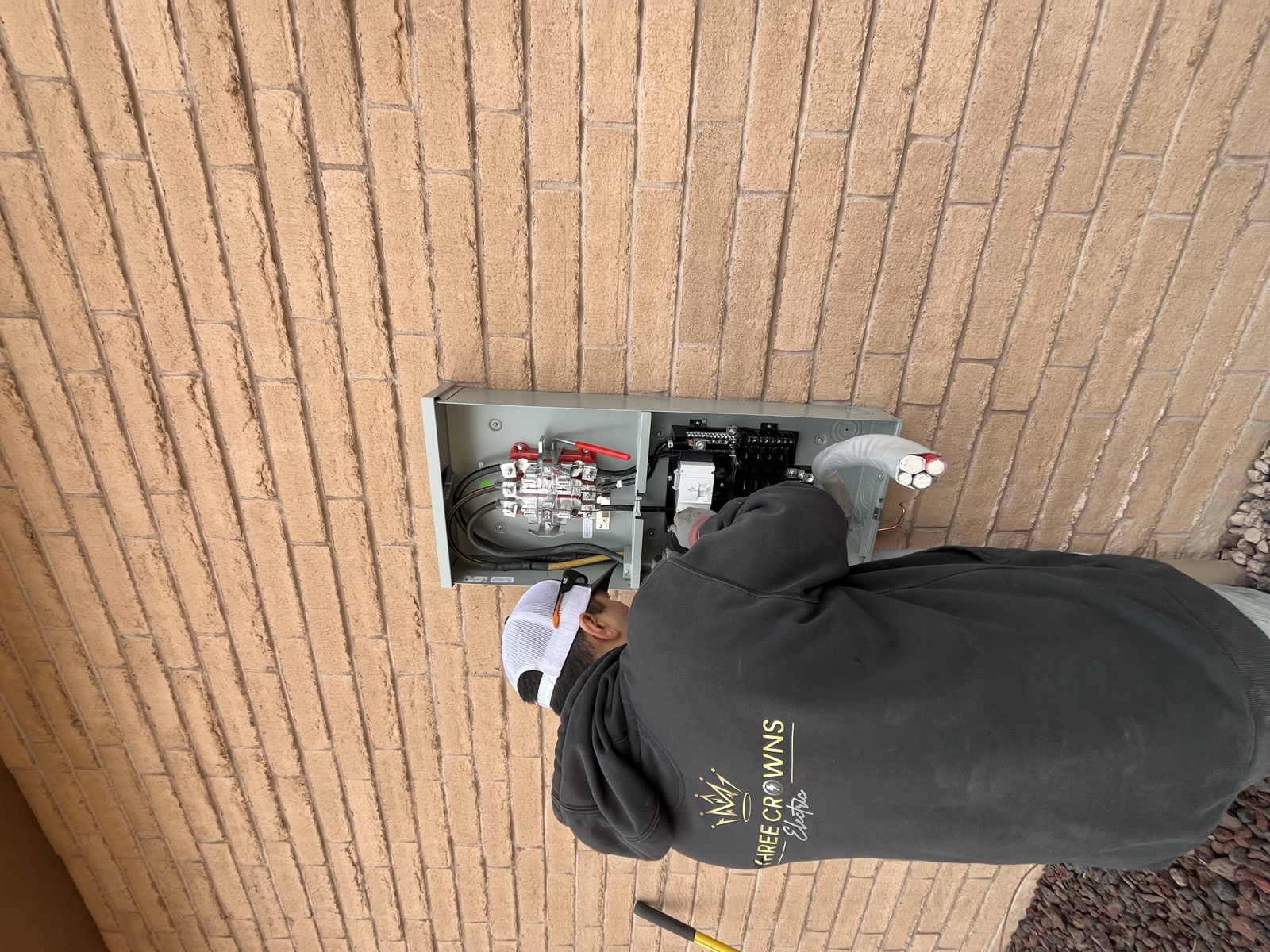
That’s a partial outage. Your home is fed by two 120-volt legs from the utility. One of them has lost contact somewhere — usually a loose neutral at the meter base, a damaged feeder between meter and panel, or an overheated bus bar inside the panel itself. Half the circuits in the house run on each leg, so when one drops, half the house goes dark in a pattern that always looks weirder to the homeowner than it is to us.
The signature sign: the breakers don’t appear tripped, but specific 120V circuits are dead while the 240V appliances (dryer, range, AC) sometimes still run, sometimes run at half voltage, sometimes don’t run at all.
This is a same-day call for us. The reason is that running on a degraded leg is hard on appliances — the fridge compressor, the furnace blower, the AC condenser are all rated for 120V or 240V steady. Anything outside that range shortens their life. We come today, find the failed connection, show it to you on the meter, and quote the fix before any wire gets cut.
Most partial outages are fixed for $300–$700 (loose neutral, terminal repair). A small percentage involve damaged feeder wire that requires a small section replaced — those run higher. We quote both numbers up front.
I smell something burning near an outlet — is it an emergency?
Yes. A burning smell from an outlet means something inside the wall is heating past its rated temperature, and that’s how electrical fires start. Cut power to that circuit at the panel if you can do it safely, stop using the outlet, and call us.
We route burning-outlet calls ahead of routine work, every time. The fix usually isn’t expensive — a melted backstab connection or a loose pigtail can be repaired in 30 minutes — but the consequence of waiting can be a wall fire. We’d rather show up the same day for a $185 fix than the next week for a fire investigation.
For after-hours burning smells, this crosses into emergency electrician territory — call us regardless of the time. A real person answers our phone.
Why do my lights flicker when the AC or fridge kicks on?
A brief dim when a big motor starts (AC compressor, well pump, fridge compressor) is normal physics — that motor is pulling several times its rated current for a fraction of a second to overcome inertia, and the voltage drops slightly across the house wiring during that surge. If the lights settle back to normal in under a second and you’ve always seen it, it’s nothing.
What isn’t normal:
- A steady flicker that didn’t used to be there
- A flicker that spreads across multiple circuits or the whole house
- A flicker that gets worse over time
- Lights dimming when nothing big is starting
Those three patterns point to a loose neutral, a failing breaker, an undersized service feed, or a utility-side problem. We test all three on the diagnostic visit instead of guessing. Some of these fixes are simple ($150–$300). Some of them point to a real service feed issue that involves the meter base and Xcel coordination.
The diagnostic isn’t expensive. The wrong diagnosis on a flicker is — we’ve seen homeowners pay $4,000 for a panel they didn’t need when the actual problem was a $250 utility-side neutral repair.
How much does an electrical repair visit cost?
Most residential repair visits land between $150 and $500 depending on the problem. That includes the diagnostic visit, the written quote, and the repair itself for simple fixes. Bigger jobs get an itemized quote BEFORE any work happens, so you always see the number first.
| Repair scope | Typical cost | Examples |
|---|---|---|
| Single-outlet / single-circuit fix | $150–$300 | Replace failed receptacle, repair loose connection, restore tripped GFCI |
| Multi-circuit diagnostic + fix | $300–$500 | Trace flickering lights, repair partial outage, replace failing breaker |
| Wiring repair section | $500–$1,200 | Replace damaged feeder, rewire short section, repair junction box fire damage |
| Whole-circuit replacement | $800–$2,500 | Run new 20A circuit, replace knob-and-tube section, fix aluminum branch wiring |
We never charge for the quote. We never start work until you’ve seen the number. We’ve never written a change order without your sign-off. This is the part of the business where homeowner trust gets built or broken — we’re explicit about it on every call:
We quote the fix. You decide. Then we work.
Can you come today?
Most days, yes — especially for partial outages, burning smells, or dead circuits that affect the kitchen, HVAC, or any safety-critical load. We’re usually rolling to a repair call within a couple of hours during business hours.
If we’re full for the day, we’ll tell you straight on the first call instead of promising a window we can’t hit. After-hours, the call routes to our emergency electrician line, which a real person answers — not a bot, not a third-party answering service, not a queue.
We service all 19 Northern Colorado towns, but priority dispatch is anchored in Fort Collins, Loveland, Windsor, Greeley, and Boulder for same-day work. Pick your town for local-specific lead times and after-hours coverage.
Last reviewed by a Master Electrician: April 29, 2026.
Have an electrical problem you can’t figure out? Call (970) 460-0014. We diagnose it, show you what’s actually wrong, and quote the real fix — no panel upsell, no commission-driven scope creep, no surprise bills.