If you’re asking “do I need a permit to install an EV charger,” the short answer is yes. A hardwired Level 2 charger or a new 240V circuit needs an electrical permit in every Northern Colorado town we work in — Fort Collins, Loveland, Greeley, Windsor, and the rest. Plugging a portable charger into an existing, properly installed 14-50 outlet does not. The permit means an inspector verifies the circuit size, wire gauge, and GFCI protection before you trust the install with a 40-amp continuous load every night. We pull the permit and handle the inspection on every job.
Here’s the situation we see every week. The new EV has a delivery date. One quote includes “permit and inspection” as a line item; a cheaper quote never mentioned a permit at all. Now you’re wondering whether the permit is a real requirement or just padding on the invoice.
It’s real. A Level 2 charger runs 40 to 48 amps, continuously, for hours, usually while you’re asleep. That’s one of the largest sustained loads in your house. Every town in Northern Colorado treats a new EV charger circuit as permitted electrical work — and about half the time the job also opens a bigger question about whether your panel can carry it at all. We see close to a 50/50 split across our EV charger installs.
Yes — a new EV charger circuit needs an electrical permit
Any install that adds a new 240V circuit needs a permit. That covers the three ways most Level 2 chargers get installed:
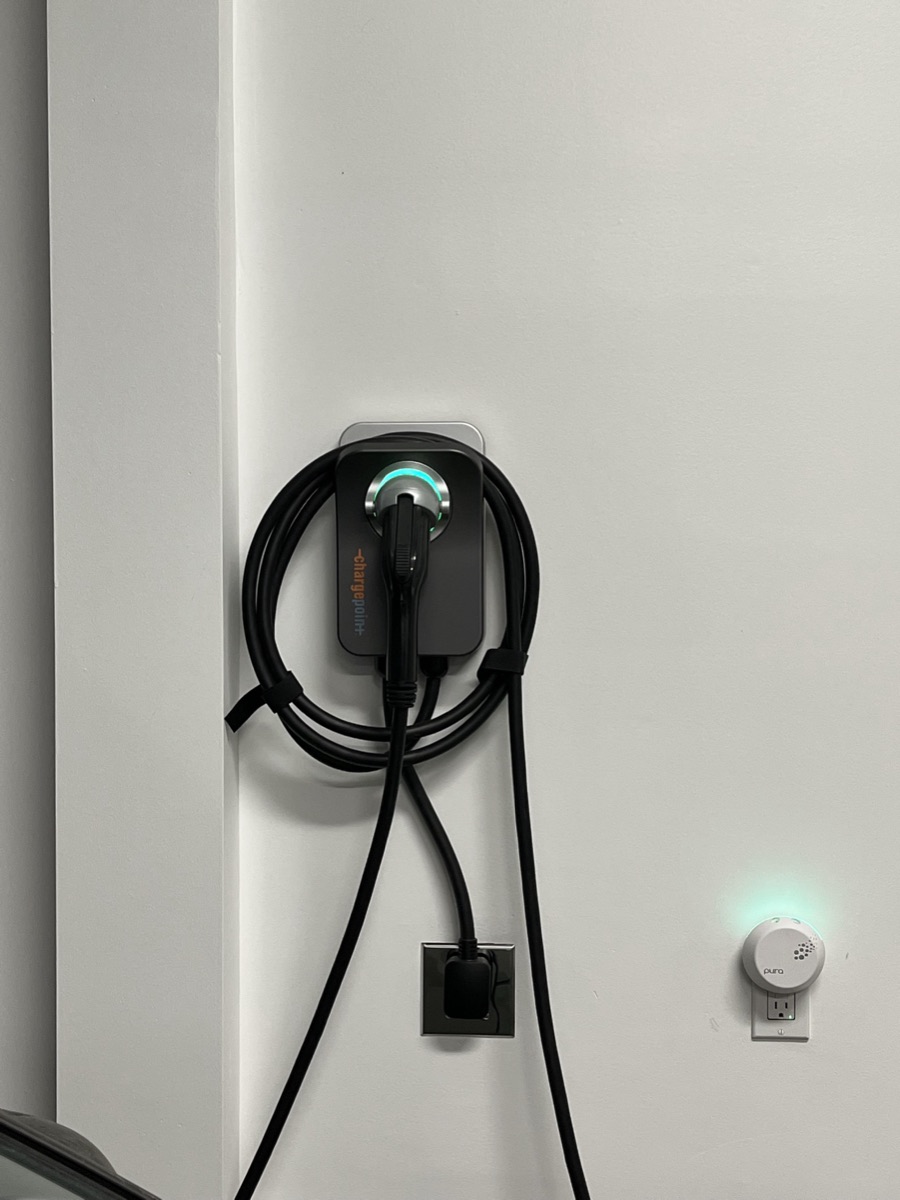
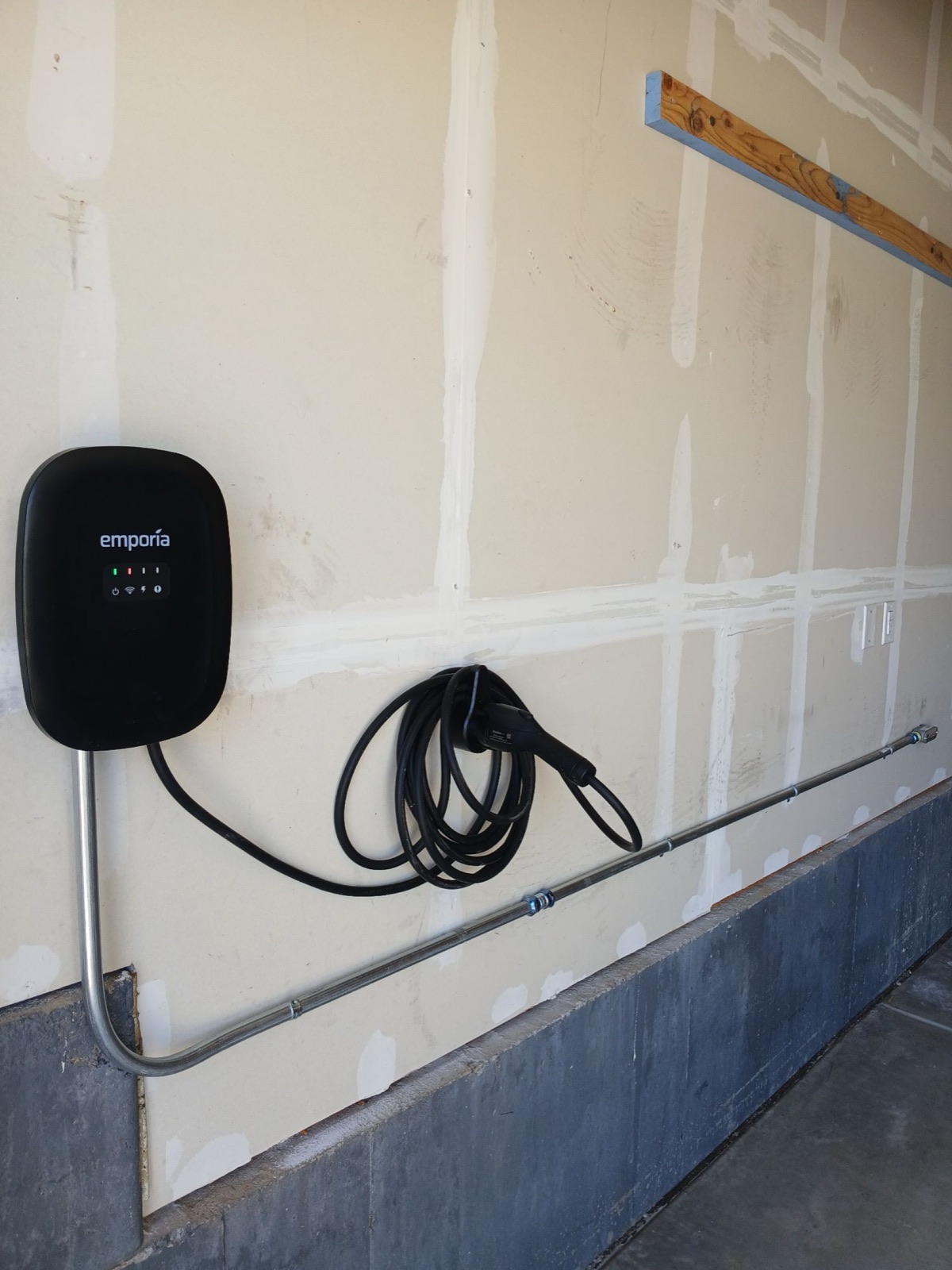
- Hardwired charger (Tesla Wall Connector, ChargePoint, Wallbox, and similar) on a dedicated 50 or 60-amp circuit
- New NEMA 14-50 outlet on a dedicated 50-amp circuit, for a plug-in charger
- Panel upgrade plus charger circuit, when the load calculation says your existing panel can’t take another 50 amps
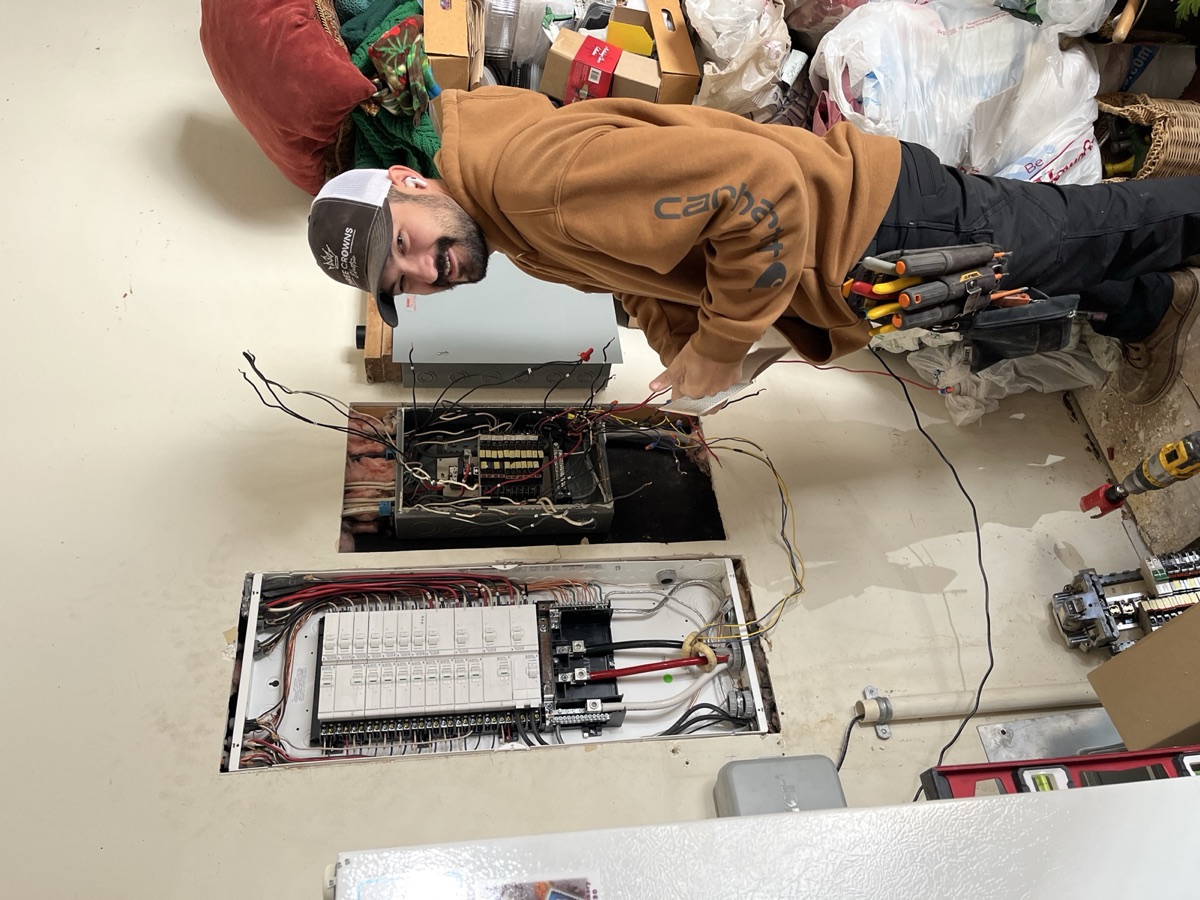
In all three cases, the work involves your panel, a new breaker, and new wire. That’s permitted work everywhere we operate. And if the job includes a service upgrade, the utility won’t reconnect you without it.
“Anytime there’s an upgrade, we got to coordinate with the local utility provider as well with the local building department. So we do pull permits. Utility providers don’t energize our new service until we do have permits and inspections taken care of.”
— Jon Trujillo, Master Electrician
That applies whether your power comes from Xcel Energy or Poudre Valley REA. No permit, no reconnection.
Does plugging into an existing 14-50 outlet need a permit?
No. If your garage already has a properly installed 240V outlet — say the previous owner had a welder, or an electrician put in a 14-50 a few years back — you can plug a portable EVSE into it today. Using an outlet isn’t permitted work. Installing one is.
Two cautions before you settle in with that plan:
- Confirm the outlet was actually installed right. EV charging is a continuous load, and cheap residential-grade 14-50 receptacles are known to overheat and melt under it. If you don’t know who installed the outlet or whether it was permitted, have it looked at before you charge on it nightly.
- A dryer outlet is not a charger circuit. Sharing the dryer circuit works for some light-commute situations, but it’s not a dedicated circuit — and adding a dedicated one puts you back at needing a permit.
If you’re weighing plug-in versus hardwired anyway, the hardwired route charges faster and skips the GFCI-breaker nuisance-trip problem entirely. We covered the tradeoff in hardwired vs plug-in EV chargers and the 8-amp difference.
Who issues the permit — your city, the county, or the state?
This is the part that confuses people, because Colorado doesn’t have one single permit office. It depends on your address:
- Cities with their own building departments — Fort Collins, Loveland, Greeley, Windsor, Longmont, Boulder, and most incorporated NoCo towns — issue electrical permits through their own city building department and send their own inspectors.
- Unincorporated county addresses in Larimer County go through the Larimer County building department, which runs one of the more transparent permit portals in the region.
- Some addresses route through the state. Where there’s no local electrical inspection program, permits go through the Colorado State Electrical Board instead of a city office. Parts of the mountain communities work this way.
Which office you’re in changes the paperwork and the inspector, not the requirement. If you’re not sure which jurisdiction your address falls under, check with your local building department — or give us the address and we’ll tell you, because we’re pulling permits in these offices every week.
Here’s how the towns we serve most compare:
| Town | Permit for a new charger circuit? | Garage heat detector required? | Notes |
|---|---|---|---|
| Fort Collins | Yes | Yes | City building department; heat detector adds $200–$400 |
| Loveland | Yes | No | City building department |
| Greeley | Yes | No | City building department |
| Windsor | Yes | No | City building department |
| Longmont | Yes | Yes | Same heat detector rule as Fort Collins |
| Broomfield | Yes | Yes | Same heat detector rule |
| Boulder | Yes | Varies | Some code overlays apply — confirm per address |
| Unincorporated Larimer County | Yes | No | County permit portal; some addresses route through the state board |
Fee schedules vary town to town. Budget roughly $100–$200 for the permit itself in most NoCo jurisdictions, and check with the local building department for the exact number — no city publishes a flat “EV charger permit fee.”
What does Fort Collins require that other towns don’t?
Fort Collins is real particular about one thing: if the charger is going in your garage, the city requires a heat detector mounted in the garage and wired into your home’s interconnected smoke alarm system. Longmont and Broomfield require the same. Loveland, Windsor, and Greeley currently don’t.
It’s a local amendment, not national code — yet.
“It’s not a national electrical code as of yet, but I see that definitely coming in the future.”
— Jon Trujillo, Master Electrician
The heat detector adds roughly $200–$400 to a Fort Collins install, which is usually the entire difference when a Fort Collins homeowner compares quotes with a neighbor in Loveland. It’s not an upcharge. It’s the code. We wrote up the full requirement, town by town, in Does Fort Collins require a heat detector for EV charger installation?
The practical warning: if an electrician quotes you a Fort Collins garage install and never mentions the heat detector, it’s coming up at inspection time — and so is a change order.
What does the inspector actually look for?
The inspection isn’t a formality, and in our experience the inspectors up here know exactly what they’re looking at.
“What we’ve run into with the inspectors — they’re all really well trained. Most of them are already journeyman electricians, if not have gone through intensive training on what they are looking at when it comes to service upgrades.”
— Jon Trujillo, Master Electrician
On an EV charger circuit, the inspector is verifying the things that fail when an install is done cheap:
- Circuit and breaker sizing — a 48A hardwired charger needs a 60-amp circuit; the breaker has to match the charger’s continuous-load settings
- Wire gauge and type — the conductor has to be rated for the amperage, and this is where corner-cutting installs get caught
- GFCI protection — required in the right place depending on whether the install is a receptacle or hardwired
- Terminations — connections torqued to spec, because loose terminations under continuous load are how receptacles melt
- The dedicated circuit — nothing else sharing it
- Heat detector, in the jurisdictions that require one
That list also explains why permitted quotes cost more than the $250 text-message quote. The permit guy is building to a standard someone will check. The other guy is hoping nobody ever looks.
Why do half of EV charger installs turn into a panel conversation?
Roughly 50% of our EV charger jobs in Northern Colorado end up needing a panel upgrade before the charger can go in. It’s not an upsell pattern — it’s housing stock. Homes from the 1970s and earlier around here often run the whole house on 100 amps, and adding a 50-amp continuous load to a 100-amp service doesn’t pencil.
The way to know isn’t a guess. It’s a load calculation, run on your actual panel, on the first visit. If you have headroom, the charger goes on the existing panel and the permit covers a simple circuit install. If you don’t, the panel upgrade is its own permitted, inspected job with utility coordination on top.
We wrote the full decision walkthrough in Do I need a panel upgrade for my EV charger? — including when load management lets you skip the upgrade. Either way, the load calc happens before the quote, not after the deposit.
What happens if you skip the permit?
Nothing, at first. That’s the trap. Unpermitted electrical work fails slowly and then all at once, usually in one of three ways:
Insurance. If an unpermitted install overheats and causes a fire, there’s no inspection record showing the work was done to code — and that gives your insurance carrier room to fight or deny the claim. The permit paperwork is cheap compared to arguing with an adjuster about a garage.
Resale. Home inspectors notice new 240V circuits, and buyers’ agents ask for the permit history. Unpermitted work either gets renegotiated off your sale price, or you pay for a retroactive permit and inspection under deadline pressure — always slower and more expensive than doing it up front.
Safety. The failure mode on this circuit is thermal: melted receptacles, cooked terminations, undersized wire running warm inside a wall. On a circuit that runs at full load while your family sleeps, the inspector’s second set of eyes is worth the fee.
One more version we see: manufacturer and dealer “free install” programs sometimes leave the permit out of the covered scope, and homeowners find out at the end that the city permit was never included. Read the fine print, or ask us to look at the offer before you sign.
Who pulls the permit — you or your electrician?
On every Three Crowns Electric install: we do. Permit application, inspection scheduling, the inspector walk, and the final paperwork in your hand at the end. It’s included in the quote as its own line item. You don’t call anyone.
Colorado jurisdictions do generally let an owner-occupant pull a homeowner’s permit for work on their own home, so a permitted DIY install is a legal path. The work still has to pass the same inspection, and on a 50-amp continuous-load circuit, most homeowners who start down that road call an electrician somewhere in the middle of it.
Call a licensed electrician up front if:
- The install is hardwired, or needs any new 240V circuit
- Your panel is 100A or 125A, or the house predates 1980
- Your existing 14-50 outlet is warm to the touch after charging, or the breaker trips mid-charge
- You’re in Fort Collins, Longmont, or Broomfield and the charger is going in the garage — the heat detector tie-in touches your smoke alarm circuit
- An earlier “free install” or handyman job was done without a permit and you want it inspected properly
We’ve completed 3,252+ jobs across Northern Colorado, our techs are salaried rather than commission-based, and the load calc happens before the quote. If the panel has headroom, we say so — the full scope of a typical install is on our EV charger installation page, and pricing is broken down in the Colorado EV charger cost guide.
Frequently asked questions
Do I need a permit to install an EV charger in Colorado?
Yes, if the install adds a new circuit or hardwires a charger — which covers almost every Level 2 installation. Every Northern Colorado jurisdiction we work in requires an electrical permit for the new 240V circuit, whether it’s issued by your city building department, the county, or the Colorado State Electrical Board. Plugging a portable charger into an existing, properly installed outlet does not require a permit.
How much does an EV charger permit cost in Northern Colorado?
Typically $100–$200 for the permit itself, depending on the jurisdiction. Fort Collins, Longmont, and Broomfield installs also carry the $200–$400 garage heat detector requirement, which is separate from the permit fee. We list the permit as its own line item on every quote so you see the actual jurisdiction cost, no markup.
Do I need a permit for a Level 2 charger if I already have a 240V outlet?
No permit is needed to plug into an existing outlet. But verify the outlet itself: it should have been permitted when installed, the receptacle should be commercial or EV-rated grade, and the circuit should be dedicated. If the outlet’s history is a mystery, a short inspection visit is cheaper than a melted receptacle.
Will the city know if I install a charger without a permit?
Maybe not right away. But the circuit doesn’t stay secret: home inspectors flag unpermitted 240V circuits at resale, insurance adjusters look for permit records after a fire, and a future electrician working in the panel will see the unpermitted breaker. Retroactive permits exist, but they cost more and take longer.
Who schedules the inspection — me or the electrician?
Whoever pulled the permit. When we do the install, we schedule the inspection, meet the inspector, and hand you the final approved paperwork. If you pulled a homeowner’s permit for a DIY install, scheduling and passing the inspection is on you.
Does a panel upgrade for an EV charger need its own permit?
Yes. A service or panel upgrade is permitted, inspected work in every jurisdiction, and the utility — Xcel or Poudre Valley REA — will not energize the new service until the permit and inspection are complete. About half our EV charger jobs include this step.
Planning an EV charger install in Fort Collins, Loveland, Greeley, or anywhere in Northern Colorado? Call (970) 645-3114 for a free quote. We’ll run the load calc on your panel, confirm exactly what your jurisdiction requires, and put the number — permit included — on paper before any work starts.
Last reviewed by a licensed Master Electrician: August 2026