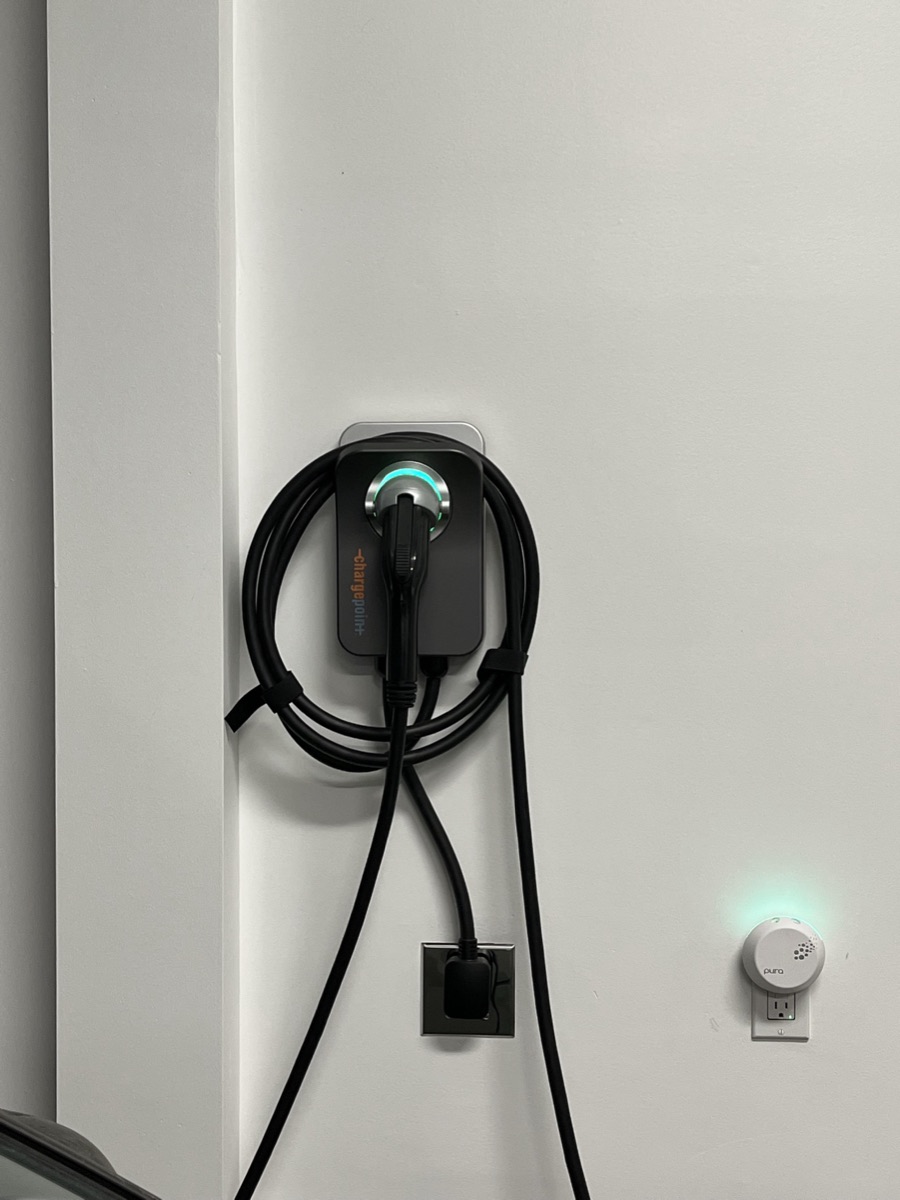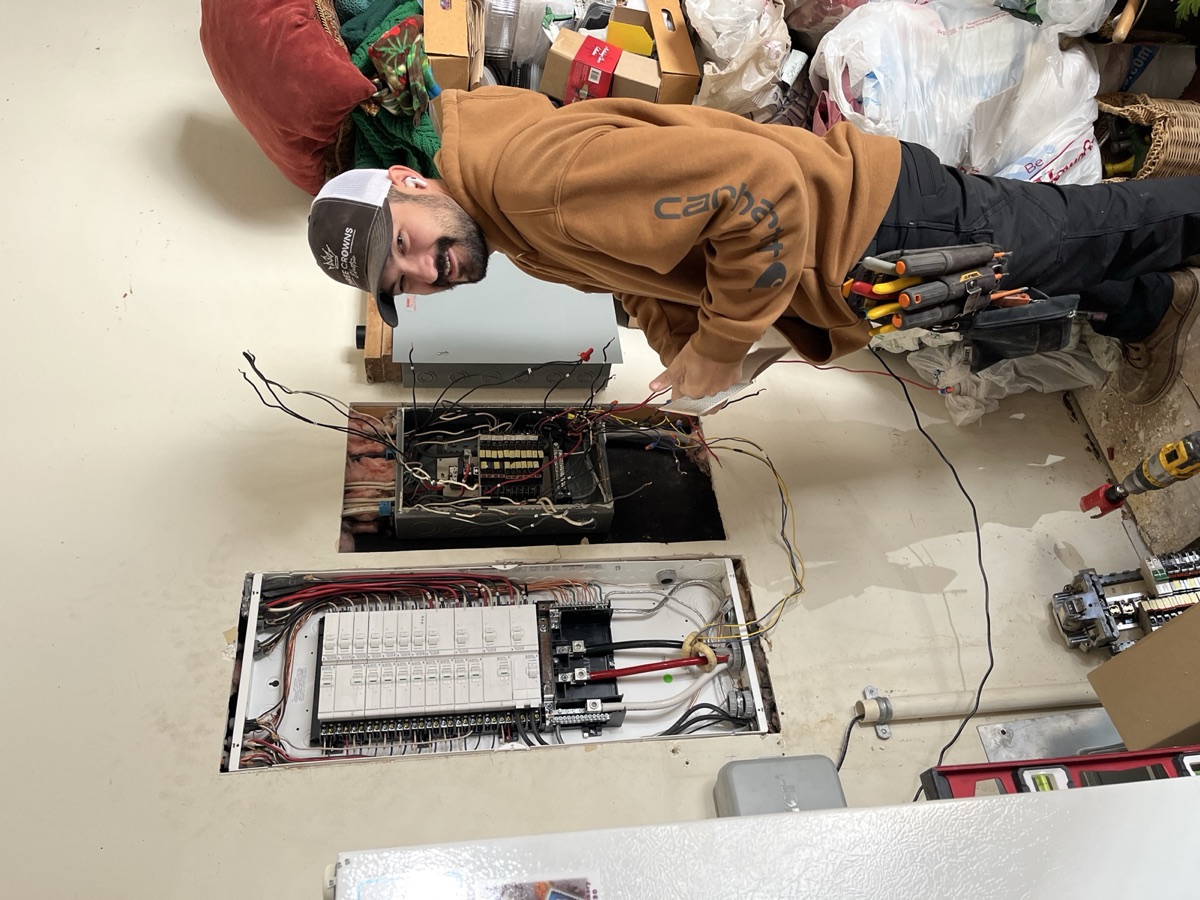
If you’re installing an EV charger in your garage in Fort Collins, Longmont, or Broomfield, local code requires you to add a heat detector wired into your existing smoke detector system. Loveland, Windsor, and Greeley do not currently require it. This is a local jurisdiction requirement — not part of the national NEC code yet — and it adds roughly $200–$400 to the EV charger install. The heat detector exists so the household gets notified if the EV or charger overheats while charging.
We get this question on almost every EV charger install in Fort Collins. The customer’s neighbor in Loveland just got a charger installed for $1,200 and the customer in Fort Collins is being quoted $1,500 — and the difference, more often than not, is the heat detector.
This isn’t a TCE upcharge or a markup. It’s a real local code requirement that catches homeowners off guard, especially when they’re comparing quotes against work done in different towns. Here’s what it actually means, what jurisdictions require it, and why it exists.
What’s actually required?
In Fort Collins, Longmont, and Broomfield, the local building department requires that any new EV charger installed in a garage has a heat detector mounted in the garage ceiling and wired into the home’s existing interconnected smoke alarm system.
“They’re real particular now that they’re starting to want heat detectors installed in garages. So if you’re looking at getting electrical vehicle charger installed in your garage now we have to do additional work to come off of your smoke detector system and install a heat detector in your garage. So if something was to heat up or catch fire as you’re charging your vehicle, then it’s going to be notifying the household if you had any emergency situations.”
— Jon Trujillo, Master Electrician
The heat detector is a separate device from a smoke detector — it triggers when the ambient temperature crosses a threshold (typically 135°F), not when smoke is detected. Garages are exempt from smoke detector requirements because of the dust and exhaust that triggers false alarms, but heat detectors don’t have that problem.
The wiring runs from the new heat detector back to the home’s smoke alarm circuit so when one device alerts, the whole interconnected system alerts. If your EV is charging at 2am and starts overheating, every smoke alarm in the house goes off — not just the one in the garage that nobody can hear.
Which Northern Colorado towns require it?
This is the part most homeowners don’t realize varies by jurisdiction:
| Town | Heat detector required? | Notes |
|---|---|---|
| Fort Collins | Yes | Required on every new garage EV charger install |
| Longmont | Yes | Same requirement |
| Broomfield | Yes | Same requirement |
| Loveland | No | Not currently required — saves $200–$400 |
| Windsor | No | Not currently required |
| Greeley | No | Not currently required |
| Boulder | Variable | Some Boulder code overlays apply — confirm per address |
| Berthoud | No | Not currently required |
| Wellington | No | Not currently required |
| Estes Park | No | Not currently required |
“Fort Collins does. Longmont area has it. Broomfield areas requiring it.”
— Jon Trujillo, Master Electrician
The reason for the patchwork is that local building departments adopt code amendments at different paces. Fort Collins, Longmont, and Broomfield all adopted the heat detector requirement as a local amendment to the International Residential Code; Loveland, Windsor, and most of Weld County have not done so.
If you live on the boundary between two jurisdictions (say, the unincorporated Larimer County area between Fort Collins and Loveland), the requirement depends on which jurisdiction issues the permit. We confirm on every quote based on the exact address.
Is this a national code change coming?
Probably yes, but not yet:
“It’s not a national electrical code as of yet, but I see that definitely coming in the future.”
— Jon Trujillo, Master Electrician
The reason it’s likely coming nationally: as EV adoption scales, garage charging fires (rare but real) become a more visible risk. The NEC and IRC are both moving toward more proactive fire protection in residential garages, and the heat detector requirement is one of the simplest interventions. We’d expect the next major code revision cycle (2027 or 2030 depending on jurisdiction) to include some version of this rule nationally.
For homeowners installing a charger today in a town that doesn’t require it (Loveland, Windsor, Greeley), there’s an argument for adding the heat detector voluntarily — same fire-safety benefit, and you won’t have to retrofit it later if the code changes.
What does the heat detector actually cost on the install?
Roughly $200–$400 added to a typical EV charger install — that covers the heat detector device, the wire run from the garage to the existing smoke detector circuit, and the labor to make the connection.
| Cost component | Typical |
|---|---|
| Heat detector device (interconnected, 135°F rated) | $40–$80 |
| Wire run to existing smoke alarm circuit | $80–$180 |
| Labor (typically 1–1.5 hours added to install) | $80–$140 |
| Total added to EV charger install | $200–$400 |
The wire run is the variable part. If your existing smoke alarm circuit runs through the attic above the garage, the run is short and the cost is at the low end. If we have to fish wire through finished walls or run a longer path, the cost is at the high end.
We always quote it as a separate line item on Fort Collins / Longmont / Broomfield jobs so you see exactly what the local code requirement is costing. There’s no markup — it’s the same labor we’d quote for any added smoke alarm work.
What if my house has hardwired-only smoke alarms (no interconnected circuit)?
Older homes (typically built before 1990) sometimes have battery-only smoke detectors instead of an interconnected circuit. In that case, the install gets more involved:
- We add a battery-backed interconnected smoke alarm system (required by current code anyway during major electrical work)
- We tie the new garage heat detector into that new interconnected circuit
- The total scope grows from $200–$400 to roughly $800–$1,500
For most homes built in the 1990s or later, the interconnected smoke alarm circuit already exists — the heat detector tie-in is straightforward.
How does the heat detector affect Loveland or Windsor installs?
It doesn’t — those towns don’t require it. We install EV chargers in Loveland, Windsor, and Greeley without the heat detector and the install passes inspection without it.
That said, some Loveland and Windsor homeowners ask us to install one voluntarily after we explain the safety reasoning. It’s a small added cost ($200–$400), the same fire-safety benefit applies, and if the national code eventually adopts the requirement (likely in the next 5–10 years), you won’t have to retrofit it.
The decision is yours. We tell you straight what’s required by your local code and what’s optional, then quote both options.
What we include in every EV charger install
Heat detector aside, the full scope of every EV charger install we do across Northern Colorado includes:
- Site visit + load calculation (does your panel have capacity for the new circuit?)
- Permit pulled with your local jurisdiction
- Dedicated 240V 50A circuit from panel to charger location
- GFCI protection (at the breaker or at the disconnect)
- Heat detector (Fort Collins / Longmont / Broomfield only)
- Final inspection
- Charger commissioning and walk-through
For the full breakdown of what an EV charger install actually costs and what’s involved, see our EV charger installation page. About half our EV charger jobs in Northern Colorado also need a panel upgrade — if you’re not sure whether your panel can handle a 50A circuit, we run the load calc before quoting anything.
Last reviewed by a Master Electrician: May 5, 2026.
Have questions about your specific EV charger install in Fort Collins, Longmont, Loveland, or anywhere in Northern Colorado? Call (970) 460-0014 for a free estimate. We’ll come look at your panel, walk the route to your charger location, confirm whether your jurisdiction requires the heat detector, and put a written quote on paper before any work starts.