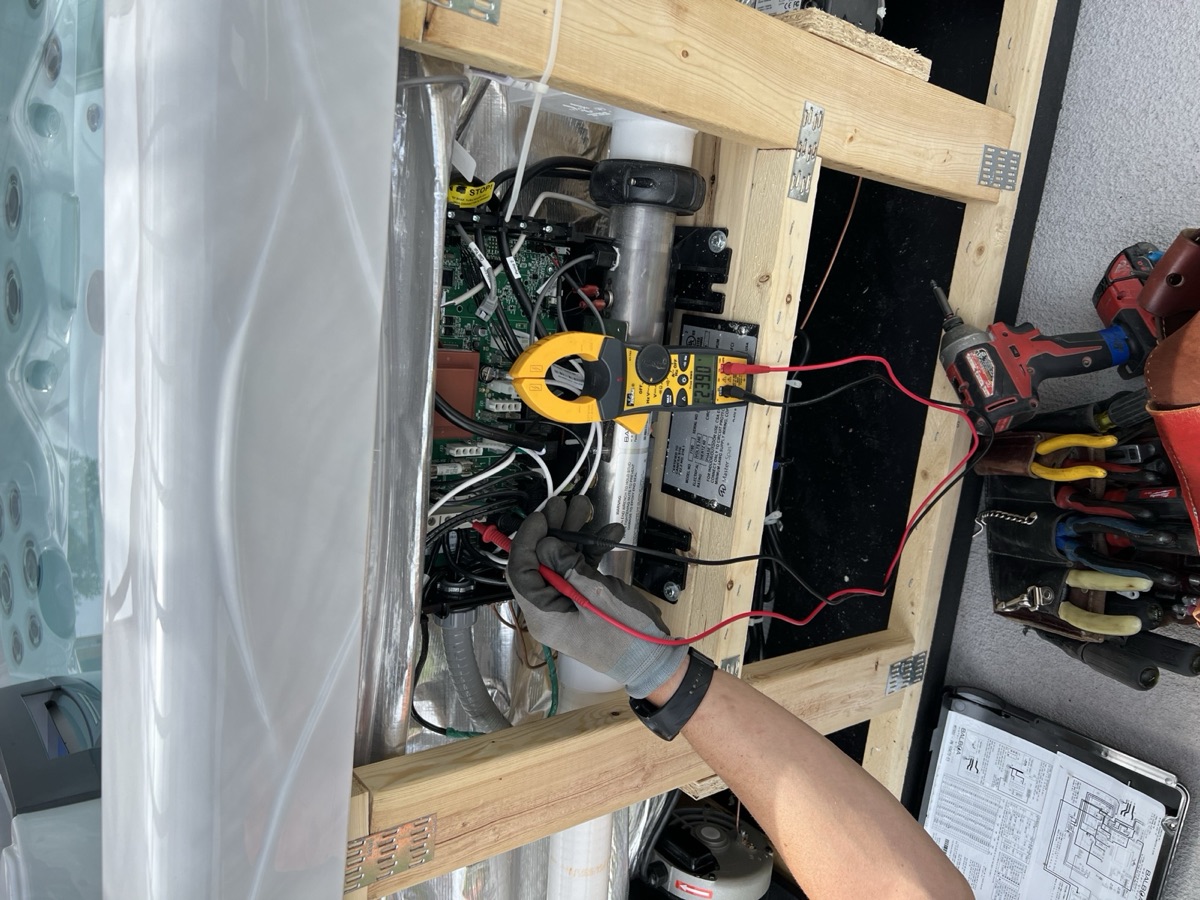
For a typical Northern Colorado hot tub install — a new 50-amp circuit from a panel with room, a 20-to-40-foot run to the tub, and a GFCI disconnect on a post next to it — expect $1,400–$1,800 flat-rate. Big-box or “spa-flipper” electricians quote $4,000–$7,000 for the same scope. Dealer-referred installers usually quote $1,200–$1,600, and the very cheapest $300–$600 quotes are typically missing the disconnect, the bonding, or the GFCI — all three of which fail inspection. The cost goes up from there when your panel can’t take another 50A circuit, when the run is over 60 feet (the trench), or when your tub brand needs something specific (Bullfrog mandates Square D QO; Hot Spring wants two circuits, not one).
A real verbatim from r/Longmont in April:
“I just need a skilled electrician that services hot tubs we can afford.”
That’s the whole problem in one sentence. The buyer just paid $11,000+ for the tub, got four quotes that ranged from $1,200 to $4,000 for the wire, and has no way to tell which one is right. Here’s the honest line-item.
The typical Northern Colorado install — what $1,400–$1,800 actually buys
This is the scope on most NoCo hot tub jobs we do: a new dedicated 50-amp 240V circuit from a panel that has room, a 20-to-40-foot run from the panel to the tub (some of it inside, some of it outside), a GFCI disconnect mounted on a 4×4 post within sight of the tub, and equipotential bonding. Tub delivered, sitting on the pad, no power yet. Owner manual on the counter. Job done in a day.
The flat-rate breakdown:
| Line item | What it is | Typical cost |
|---|---|---|
| 50A double-pole breaker | The breaker in your panel (Square D, Eaton, or Siemens — depending on what your panel takes) | $40–$120 |
| 6/3 NM-B or 6 AWG THHN in conduit | The wire from panel to disconnect | $80–$160 |
| GFCI disconnect spa pack (Midwest, GE, or Square D) | The required disconnect within sight of the tub | $150–$280 |
| 4×4 PT post, conduit, fittings, weatherheads | Hardware to mount the disconnect | $60–$110 |
| #8 bare copper bond + ground rod | Equipotential bonding (NEC 680.26) | $30–$80 |
| Labor (1 tech, 4–6 hours typical) | Pull permit, run wire, mount disconnect, bond, terminate, test GFCI, walk through | $900–$1,150 |
| Permit + inspection coordination | Larimer / Weld / Boulder county permit | $80–$160 |
| Total flat-rate | $1,400–$1,800 |
That’s the all-in number. No surprises mid-project. No “well, turns out we needed…” call from the truck.
A real review from a NoCo Bullfrog A5 customer:
“Knew the Bullfrog Square D requirement before I mentioned it. Flat-rate quote. Showed up the day they promised. $1,640 done. Wife’s first soak tonight.”
That’s the install. Now the question is why other electricians quote $300 or $7,000 for the same thing.
Why the same install gets quoted $300 and $7,000
We see this pattern every spring. Customer calls four electricians, gets four wildly different numbers, can’t tell which is real.
The $300–$600 quote. Usually one of three things: (1) the electrician is pulling a fresh circuit but skipping the GFCI disconnect — that’s a code violation under NEC 680 and an inspector-fail; (2) they’re tapping into an existing outdoor circuit instead of pulling a new dedicated one — also a code violation, NEC 680 requires dedicated; (3) they’re not bonding the metal components within 5 feet of the water — the most common bonding fail, and the one that requires tearing up the concrete pad to fix after the fact. There’s a story on r/hottub from Ontario where a homeowner had to do exactly that. Don’t be that.
The $1,200–$1,600 dealer-referred quote. Usually legitimate, often missing one thing: brand-specific breaker requirements. Bullfrog spas mandate Square D QO/QOB breakers specifically — the dealer rep will tell you once and then it gets forgotten. If the electrician installs an Eaton breaker, you’ll fight GFCI nuisance trips for the life of the tub. The cheaper quotes also tend to skip the freeze-protection circuit, which matters if you plan to use the tub year-round in NoCo (you do — that’s why you bought it).
The $4,000–$7,000 “spa-flipper” quote. Sometimes warranted, usually not. The legitimate reason for a quote this high: your panel actually can’t take another 50A circuit and needs to be upgraded first ($3,400–$5,000 added). Or your run is 80+ feet through a yard that needs a trench ($800–$1,500 added). The illegitimate reason: the electrician marked up the same scope 3× because they only do hot tubs and charge what the market will bear. You’ll know it’s the latter if they quote “$4,000 all in” without itemizing what’s in it.
The $4,200 “needs a panel upgrade” quote on a panel that doesn’t actually need one. This one we see a lot. Older panel, electrician walks up to it, says “you’ll need a panel upgrade before we can do this.” Sometimes true. Often not — there’s an NEC load calculation (NEC 220.82) that determines whether your existing 200A panel can take a new 50A circuit. We run it on every quote. If your panel can take it, we say so. If it can’t, we tell you exactly which loads are pushing it over and what your options are (panel upgrade, load manager, or skip a different circuit).
What’s actually in the typical NoCo quote — and what’s not
Here’s the cost-adder table. Anything not on this list is in the $1,400–$1,800 base quote.
| Cost adder | When it applies | Typical add |
|---|---|---|
| Panel upgrade (100A → 200A) | Older home, existing panel maxed | $3,400–$5,000 |
| Sub-panel for the hot tub | Cheaper than full upgrade in some cases | $1,500–$2,500 |
| Trench beyond 60 feet | Tub on far side of yard | $15–$25 per linear foot |
| Second circuit (Hot Spring spas) | Hot Spring mandates a 30A + a 20A circuit | $400–$700 |
| Freeze-protection circuit | Year-round NoCo usage (recommended) | $150–$300 |
| Mountain-cabin install (Estes Park, Glen Haven) | Trip, freeze-protection, sometimes a 200A → 320A upgrade | Variable |
| Pad already poured without bonding | Concrete-pad rework | $400–$1,200 |
| Decorative conduit or stub-up location | Custom routing | $100–$300 |
If your tub install is on this list, the quote will be higher than $1,800 — and that’s correct. If your install isn’t on this list and someone is quoting $4,000, ask them to itemize. Then call us.
Brand-specific requirements most electricians don’t know
We’ve installed about 200 hot tubs in NoCo. The brand-specific stuff is the difference between a tub that runs and a tub that nuisance-trips every other week for the next ten years.
Bullfrog. Mandates Square D QO/QOB breakers specifically. Their spa pack is built around the Square D ground-fault response curve, and Eaton or Siemens breakers will trip on transient loads that aren’t actually faults. Most NoCo electricians stock Eaton or Siemens. We carry Square D QO in the truck.
Hot Spring. Their pumps and heaters draw on two circuits — usually a 30A 240V for the heater and a 20A 120V for the ozonator/control. Most install quotes assume one circuit. If you call an electrician and they don’t ask “Hot Spring or another brand?” before quoting, the quote is wrong.
Caldera. Pumps and heaters work on a standard 50A circuit, but Caldera spas designed for the West (and explicitly marketed for cold-climate use) need a freeze-protection circuit added — a small dedicated 15A that keeps the spa controller and the freeze-protection logic powered through the coldest NoCo nights. Adding it during install is $150–$300. Adding it after the first freeze incident is closer to $400.
Jacuzzi. Standard 50A install, no brand-specific gotchas. Easy.
Master Spas / Wayfair / Costco big-box. Read the owner’s manual — the included electrical spec is usually accurate but minimal. The cheaper big-box tubs sometimes ship with the GFCI disconnect already built into the spa pack, which means we run wire to the spa pack and skip the separate disconnect post. Saves about $200. The owner’s manual will say if that’s the case; ours come in and verify on-site.
NEC 680 in 60 seconds (the bonding, the GFCI, the disconnect)
Three things in the code that drive the install scope. If your electrician doesn’t know all three, find another one.
Equipotential bonding (NEC 680.26). Every metal component within 5 feet of the water — the metal frame around the tub, any nearby metal handrails, exposed pipe, the rebar in the concrete pad if there is one — has to be electrically bonded together with #8 bare copper wire. This is what stops a fault current from finding a path through a human. It’s also the #1 inspector-fail trigger and the one that’s most expensive to fix after the fact, because the bonding ring usually has to be installed before the pad is poured.
The exception: a fully self-contained portable hot tub (where the pump, heater, and controls are all inside the cabinet and there’s no external piping) doesn’t need the exterior bonding ring around the pad. Mike Holt’s forum has a good thread on this — most homeowners don’t know, and many electricians don’t either. If your tub is self-contained, the bonding requirement is satisfied by the tub’s internal bonding lug.
GFCI disconnect distance (NEC 680.13). The disconnect must be within sight of the tub — but at least 5 feet from the water’s edge. This is the second-most-common inspector fail. The disconnect can’t be mounted on the wall right next to the tub. It can’t be tucked behind a fence where you can’t see it from the tub. It has to be visible from where you sit in the water, and far enough away that you can’t reach it from in the water. On most NoCo installs we put it on a 4×4 PT post 6–7 feet from the tub edge.
Dedicated circuit, 125% sizing (NEC 680.40 + 680.10). The tub gets its own breaker. You can’t tap into an existing outdoor circuit, even if the breaker has room. And the circuit has to be sized at 125% of the continuous load — so a tub that draws 40 continuous amps needs a 50A breaker, not a 40A. This is why the standard install is 50A even on smaller tubs.
That’s the code in a nutshell. Anyone who quotes you a hot tub install without mentioning at least the bonding and the disconnect distance hasn’t read NEC 680 lately.
NoCo-specific things that change the install
A few NoCo realities most national hot tub install guides skip.
Cold climate, year-round use. NoCo nights drop into single digits for weeks at a time and below zero a few times a winter. If you bought the tub for daily soaks, the spa pack and pump are running year-round, not just May–October. That means the freeze-protection circuit is worth the $150–$300 add — a single frozen pump replacement is $400–$800, and one frozen circulation pipe is $1,200+.
Inspector preferences. Larimer County, Weld County, and the city of Boulder all enforce NEC 680 the same way on paper, but in practice each inspector has their own preferences. Larimer tends to be strict on bonding (they will fail you if the #8 wire isn’t visible from outside the tub frame). Boulder is strict on the disconnect distance from the water. Weld is the most by-the-book.
Estes Park, Glen Haven, mountain installs. Second-home owners installing tubs at cabins above 7,000 feet have two things to plan for: a longer trench from the panel (which in older cabins is often in an inconvenient spot), and freeze-protection on a different scale — sustained sub-zero overnight lows mean the freeze-protection circuit is mandatory, not optional. We drive to Estes Park and Glen Haven without a trip charge for hot tub installs.
Wellington, Berthoud, rural propane homes. Some rural properties have panels that haven’t been touched since the 1990s. Adding a 50A circuit might be the load that pushes the panel into “needs upgrade” territory. We do the NEC 220.82 load calc on-site before quoting.
Common objections (and the honest answers)
“Can I just plug it into my existing outdoor 240V outlet?” Usually no. NEC 680 requires a dedicated circuit with GFCI protection at the disconnect. Your existing outlet was probably wired for a welder, an older hot tub, or a heater — different breaker size, different protection, no equipotential bonding. We can verify on-site in 15 minutes; if your existing circuit happens to be code-compliant for your new tub, we say so and don’t install a new one. We’ve never actually found one that works as-is, but it’s possible.
“Costco said the install is included — why do I need you?” The big-box “install” usually means tub-placement-on-pad: they drop it, level it, walk away. The electrical to power it is on you. We work with Costco, Wayfair, Amazon, and Sam’s Club hot tub buyers every season. Bring us your owner’s manual; we know the spec for every major brand. Most of our work in this cohort is post-delivery — the tub’s been sitting cold on the pad for two weeks because the buyer didn’t know electrical was separate.
“Colorado lets me pull my own permit — why not DIY?” You can pull the permit. NEC 680 — the bonding, the disconnect distance, the 125% sizing, the brand-specific breaker — is what fails inspection. The Ontario story we mentioned earlier is the canonical horror: homeowner pulled the permit, did the install themselves, inspector failed them on the equipotential bonding, they had to tear up the concrete pad to install the bonding ring. If you want to pull the permit and DIY, we can also coach you through what the inspector will check so it doesn’t fail you mid-project. Call us; that consultation is free.
“The GFCI keeps tripping on my brand-new tub — is that the electrician’s fault or the spa tech’s?” Usually one of three things: (1) Eaton GFCI defect — there’s a manufacturer replacement program we know about and can file on your behalf; (2) the disconnect is too far from the panel and the run picks up induced voltage that trips the GFCI; (3) the spa’s bonded heater element is leaking ground — that’s the spa tech’s job to fix. If we installed the original circuit, we diagnose it free. If we didn’t, $185 service call, credited toward repair. We’ll tell you over the phone which of the three is most likely based on when it trips and what code the spa pack shows.
“My first electrician quoted $4K and the second quoted $1,200 — which is right?” Bring us both quotes. The $4K quote usually includes things you don’t need (sub-panel addition, surge upsell, panel relocation) — sometimes those are needed; we’ll tell you when. The $1,200 quote usually misses things you do need (Bullfrog’s Square D, Hot Spring’s second circuit, freeze-protection, sometimes the bonding). We line-item ours so you see what’s in it. The typical NoCo install lands $1,400–$1,800 flat-rate.
What to ask any electrician before you hire them for hot tub wiring
Five questions. If they don’t have clean answers to all five, find another one.
- What brand of breaker do you stock? (Bullfrog needs Square D QO. If they say “whatever the supply house has,” that’s not the right answer for a Bullfrog.)
- How far from the water are you mounting the GFCI disconnect? (Answer should be “within sight, 5+ feet — usually on a post about 6 feet away.”)
- How are you handling the equipotential bonding? (Answer should include “#8 bare copper, every metal component within 5 feet of water” — or if it’s a self-contained portable tub, “the tub’s internal bonding lug satisfies it.”)
- Will you do the NEC 220.82 load calc on my panel before quoting? (Answer should be yes. If they say “you’ll probably need a panel upgrade” without doing the calc, get another quote.)
- What’s your flat-rate quote, itemized? (You want a number, not “depends on what we find.” We give the number from photos plus a 15-minute panel walkthrough.)
How we quote hot tubs at Three Crowns Electric
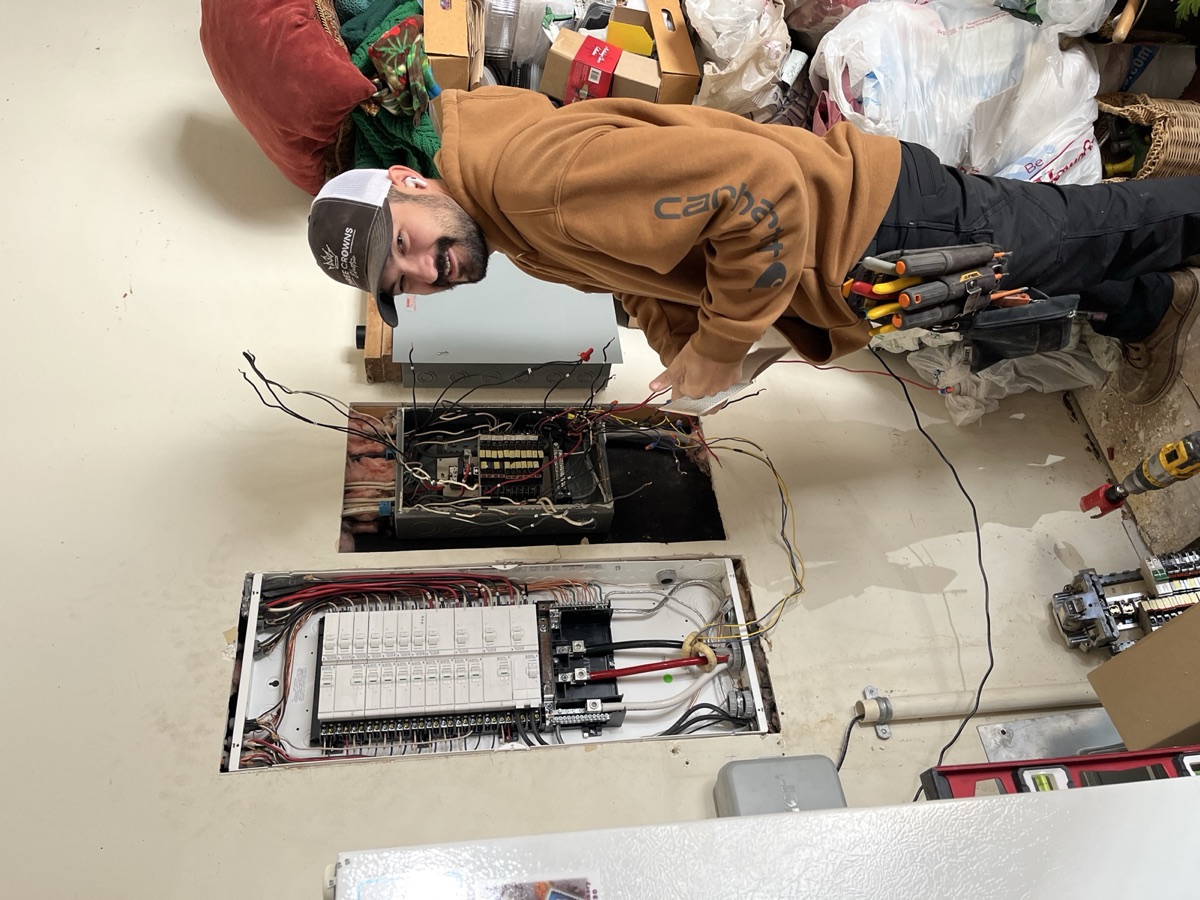
We’re family-owned, Loveland-based, and our Master Electrician has been doing electrical work in Northern Colorado for 20 years. Our techs are salaried — not commissioned — so they’re not trying to upsell you a panel upgrade that isn’t necessary. We carry Square D QO breakers in the truck for Bullfrog jobs, we know Hot Spring’s two-circuit setup, and we configure the freeze-protection circuit standard for any NoCo install you’ll run year-round. We have 518 five-star Google reviews.
We’ll quote your job flat-rate before delivery from photos plus a 15-minute panel walkthrough. If the quote turns out to be wrong on the day — we discover something the photos didn’t show — you get 50% of our profit back, in writing. Two-year warranty on the install. Tub running by the day we promised, or we keep working until it is.
Call (970) 645-3114 — a real person will answer, even on weekends.
Last reviewed by Jon Trujillo, Master Electrician — 2026-05-22.