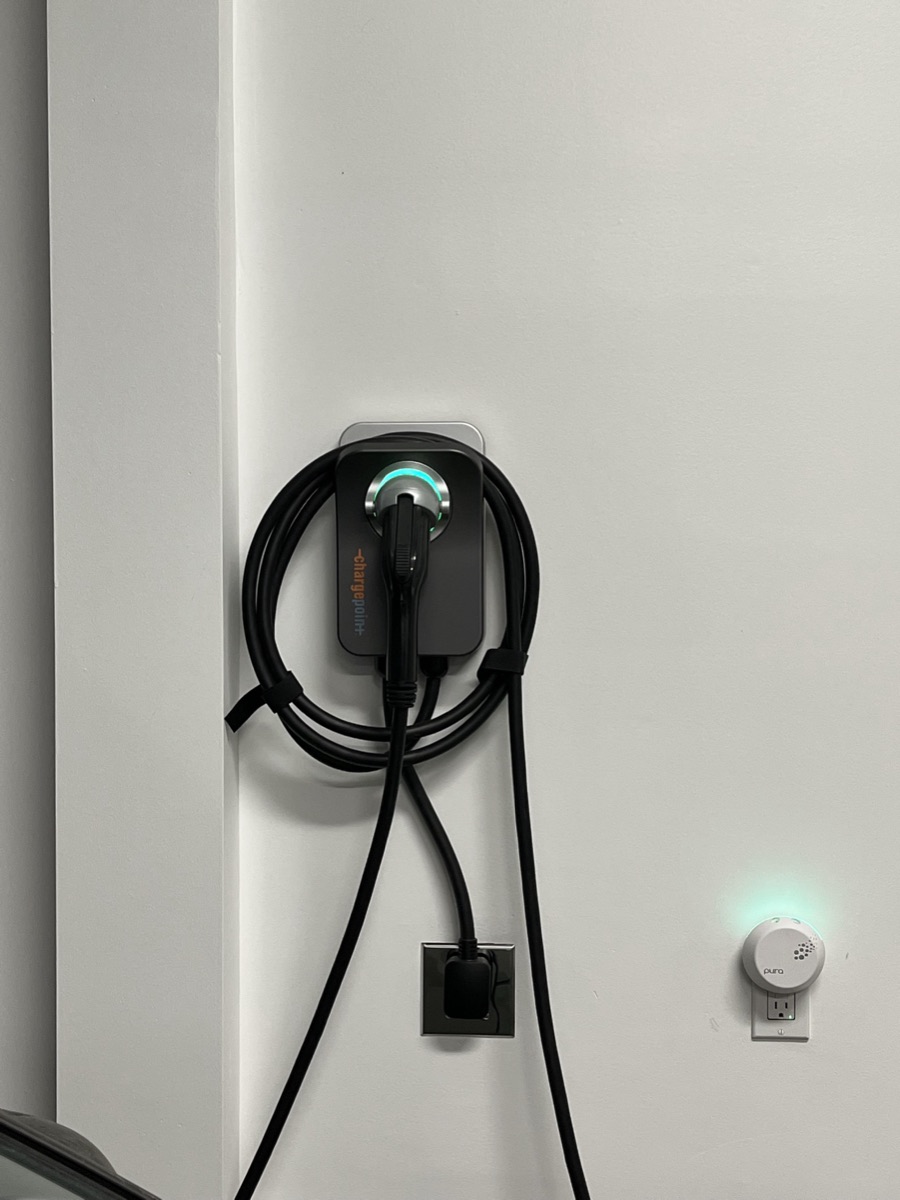
A hardwired EV charger runs at 48 amps. A plug-in version caps at 42 amps because all 240V outlets are rated to 50A maximum and you can’t run continuous load above 80% of the outlet rating. That 8-amp difference saves about 2 hours of charge time on smaller-battery EVs. Hardwired is the right call for nearly every household. The one real reason to choose plug-in: garage flexibility — you can unplug the charger and use the outlet for a welder or electric heater. Both options use the same 240V 50A dedicated circuit.
The hardwired vs plug-in question is the most common one we get on EV charger calls, and the answer most homeowners get from their EV manufacturer is incomplete. Tesla, Ford, GM, Rivian — they all sell chargers in both configurations and let you decide. What they don’t always explain is the actual amperage difference, what it means for charge time, and why the difference exists in the first place.
Here’s the real breakdown from someone who’s installed roughly 1,000 EV chargers across Northern Colorado.
Why does the amperage cap differ?
It comes down to the National Electrical Code’s rules on continuous loads on standard outlets.
“I always highly recommend the hardwire because then you can fully set the charger to its max capabilities. If you do the plug in style, then you can only set your charger to 42amps because all outlets are only rated up to 50amps max. So you can set the charger for 42amps versus if you hardwire you can set the charger to 48amps.”
— Jon Trujillo, Master Electrician
The code rule: a standard 240V outlet (NEMA 14-50) is rated for 50 amps maximum, but you can only run continuous load (more than 3 hours) at 80% of the outlet’s rating. 80% of 50A is 40A — and most modern EV chargers are designed to run at 32A or 40A on plug-in installs.
A few chargers (including the Tesla Wall Connector and ChargePoint Home Flex) can be configured to 42A on plug-in by adjusting internal settings to push the limit, but anything above 40A on a plug-in install requires careful charger model selection. Most plug-in installs land at 32A or 40A in practice.
When you hardwire the same charger, those rules don’t apply because there’s no outlet — the charger is permanently terminated to a 50A dedicated circuit. The charger can use the full 48A continuous draw the underlying NEC rules allow on a 60A circuit (which is typically what’s required for a 48A charger).
What does 8 amps actually mean for charge time?
“It’s difference of 8amps. So you get 8, 8 additional amps of charging. So 42amps for the plug in version. And then you can get 48amps for the hardwire.”
— Jon Trujillo, Master Electrician
“You’d be surprised on some of the smaller battery vehicles getting that extra amperage to charge a car. You might be saving your charge time down by two hours. So you might wait additionally two hours longer for a plug in version versus the hardwired version.”
— Jon Trujillo, Master Electrician
The math: 48A vs 40A is a 20% increase in charging speed. On a typical EV that takes 8 hours to fully charge at 40A, the hardwired version takes about 6.5 hours — that’s the “2 hour” savings.
| EV battery size | 40A plug-in (full charge) | 48A hardwired (full charge) | Time saved |
|---|---|---|---|
| Tesla Model 3 Standard (60 kWh) | ~7 hours | ~5.5 hours | 1.5 hours |
| Tesla Model Y Long Range (75 kWh) | ~9 hours | ~7 hours | 2 hours |
| Ford F-150 Lightning Standard (98 kWh) | ~11.5 hours | ~9 hours | 2.5 hours |
| Tesla Model S Long Range (100 kWh) | ~12 hours | ~9.5 hours | 2.5 hours |
| Ford Mustang Mach-E (88 kWh) | ~10.5 hours | ~8.5 hours | 2 hours |
(Charge times are approximate and assume charging from 10% to 100%. Real-world charge time depends on battery temperature, charger efficiency, and the car’s onboard charger limits.)
For homeowners who plug in at 10pm and need the car ready by 6am — the most common usage pattern — those 2 hours can be the difference between fully charged and not. The hardwired option just works; the plug-in option sometimes runs out of time on a smaller battery EV.
When does plug-in actually make more sense?
There’s exactly one scenario where we recommend plug-in: garage flexibility.
“Also if there’s a customer that wants to use the outlet for either a garage heater or they might have a welder that they like to use, then I recommend just doing a plug in version. So then at that point you can unplug your charger, you can plug something into that power source and use it like electric garage heater.”
— Jon Trujillo, Master Electrician
A 240V 50A outlet is the same outlet a welder, electric garage heater, RV hookup, or large air compressor uses. If you have any of those use cases — or might in the future — the plug-in install lets you unplug the charger and use the outlet for the other equipment. Hardwired installs lock the circuit to the charger only.
The realistic use cases:
- Hobby welder in the garage (TIG/MIG/stick units that need 240V)
- Electric garage heater for winter
- RV hookup if you have an RV that can use a 14-50 outlet
- Future move planning — if you might move and want to take the charger with you, the plug-in is portable
For homeowners with no other 240V garage equipment and no immediate plans to move, hardwired is the cleaner answer.
The underlying circuit is the same
A common misconception: people assume hardwired and plug-in chargers need different circuits. They don’t.
“You always need to have a 240 volt 50amp circuit. So whether it’s a 240 volt 50amps circuit for an outlet to the charger to plug into or whether you hardwire direct to the charger — same thing.”
— Jon Trujillo, Master Electrician
The underlying electrical work is identical: 240V dedicated circuit, 6 AWG copper wire (typically), 50A breaker (or 60A breaker for hardwired 48A chargers). The only thing that changes is whether we terminate at a NEMA 14-50 outlet or directly into the charger’s wiring compartment.
That means the install cost is roughly equivalent — typically within $50-$150 either direction depending on charger brand and specific configuration. Don’t pick plug-in to save money on the install; the savings are negligible.
What about portability — what if I move?
This is the second-most-common reason homeowners ask for plug-in: “I might move in 5 years.”
For most homeowners, this is overstated. Here’s the real math:
- A plug-in charger costs $400-$700 to take with you (you unplug, take the charger, leave the outlet)
- The new home will need a new 240V circuit installed regardless ($1,000-$2,000 typically)
- Total cost to “move” the plug-in charger: similar to just buying a new charger at the new home
The portability benefit is real but small. We’ve installed thousands of EV chargers and seen maybe 30 customers actually take a plug-in charger with them when they moved. Most leave it for the next homeowner.
If portability is a hard requirement (frequent moves, military, etc.), plug-in is fine. If it’s a hypothetical, hardwire and don’t worry about it.
Both work — what we recommend
For 80% of households we install: hardwired. Faster charging, cleaner install, no nuisance GFCI trips on the outlet, locked-in to the charger you bought.
For the remaining 20%: plug-in, because of garage flexibility (welder, heater, RV) or genuine moving plans.
The cost is essentially the same. The decision is about how you’ll use the garage, not about saving money.
For details on EV charger installs in Northern Colorado — what we charge, what’s involved, what brands we recommend — see our EV charger installation page. About half our EV charger jobs also need a panel upgrade because the existing 100A service can’t handle the 50A circuit; we run the load calc before quoting anything.
Last reviewed by a Master Electrician: May 5, 2026.
Trying to decide hardwired vs plug-in for your specific EV install? Call (970) 460-0014 for a free estimate. We’ll walk through your garage layout, your other potential uses for a 240V circuit, and your charger model — then put a written quote on paper for the option that actually makes sense for your house.