





EV charger installation in Northern Colorado typically runs $800–$2,500 for the install (charger hardware separate). About half of all jobs also need a panel upgrade because the existing 100-amp panel can’t safely add a 50A circuit. Hardwired chargers run at 48 amps (~2 hours faster charge); plug-in versions cap at 42A. Three Crowns Electric has installed 1,000+ EV chargers across NoCo — Tesla Wall Connector, ChargePoint, Wallbox, and every other brand. Permits, load calc, and inspection included.
We’ve installed close to 1,000 EV chargers across Northern Colorado since the first Tesla Model S deliveries hit Fort Collins. The pattern is consistent: the homeowner’s car arrives in three weeks, they realize the 110V cable that came with it is going to take a week to fill the battery, and they need a Level 2 charger before the delivery date.
About half the time, that install also needs a panel upgrade — and that’s the part most homeowners don’t expect.
“We’re seeing close to about a 50 split there.”
— Jon Trujillo, Master Electrician
What follows is what we actually find on those jobs, what the install really costs, what brand to buy, and the local code quirks that catch homeowners off guard in Fort Collins and Longmont.
How much does an EV charger installation cost in Northern Colorado?
A typical EV charger installation in Northern Colorado runs $800 to $2,500 for the install itself (charger hardware separate — that’s another $400–$1,200 depending on brand). The spread depends on five things: distance from the panel to the charger location, whether we’re going through finished walls, whether the panel can handle the new 50A circuit or needs an upgrade first, hardwired vs plug-in, and whether your jurisdiction requires a heat detector in the garage.
We don’t quote over the phone. We come to the house, look at your panel, run a load calculation, and put a written number on paper.
“Installation for an EV charger requires a 50 or 60amp circuit for a level 2 home charger. So what we have to do is come evaluate your electrical panel, make sure that you don’t have 100amp service to be able to run additional 50amps of power for your level 2 charger.”
— Jon Trujillo, Master Electrician
The base case ($800–$1,200) is a charger mounted in an attached garage within 15 feet of an existing 200A panel that has the headroom — short conduit run, clean install, half a day on site. Add $400–$800 if the run goes through finished walls or to a detached garage. Add $200–$400 for the heat detector if you’re in Fort Collins or Longmont (more on that below). Add $1,500–$3,000 if the panel needs to be upgraded first — see our electrical panels page for the full breakdown.
Do I need a panel upgrade for my EV charger? (~50% of NoCo jobs do)
About half the time, yes. The reason is the math: a Level 2 charger needs a 50-amp dedicated circuit, and most homes built before the late 1990s have a 100-amp panel that’s already running a furnace, an oven, an AC, and maybe a hot tub. There’s no 50A of headroom to give.
“They definitely go hand in hand at certain times, especially when you get into those older neighborhoods from homes 70s or earlier. A lot of those homes only have 100amps of power running the entire home.”
— Jon Trujillo, Master Electrician
The second half of the homes — typically 1990s or newer with a 200A panel that’s still got headroom — we can usually get the charger installed without an upgrade. We always confirm with a load calculation before we touch a wire.
For two-EV households, the answer is almost always yes:
“If they don’t have 200amps at that point and they want two level two chargers, it’s definitely we’re looking at upgrading their service to a 200amp.”
— Jon Trujillo, Master Electrician
The trigger for the second charger comes down to schedule. Jon’s framework:
“If they can share the charger and split their days between charging, then we always recommend that first. But we do have customers that both their busy schedules, busy lives, they’re both getting up 7 in the morning, hitting the pavement, not getting home till 4 or 5 o’clock at night. So for those customers, we install two level 2 EV chargers in their homes.”
— Jon Trujillo, Master Electrician
For homes with EVs plus shops, welders, or air compressors, we sometimes go past 200A:
“You can go to a 320amp which is considered the 400amp service for a residential home. There is some that has to take place with getting prior approval from the utility company. But yes, we have definitely upgraded homes, especially homes that have shops built off to the sides of them and they’re running welders and air compressors.”
— Jon Trujillo, Master Electrician
The same site visit covers EV charger sizing, panel upgrade determination, future hot tub planning, and generator sizing — one conversation, one load calc, one quote.
Hardwired vs plug-in: which should I choose? (the 8A difference)
Hardwired. For nearly every household, the hardwired install is the right call — and the reason comes down to a specific 8-amp difference that most homeowners don’t know about.
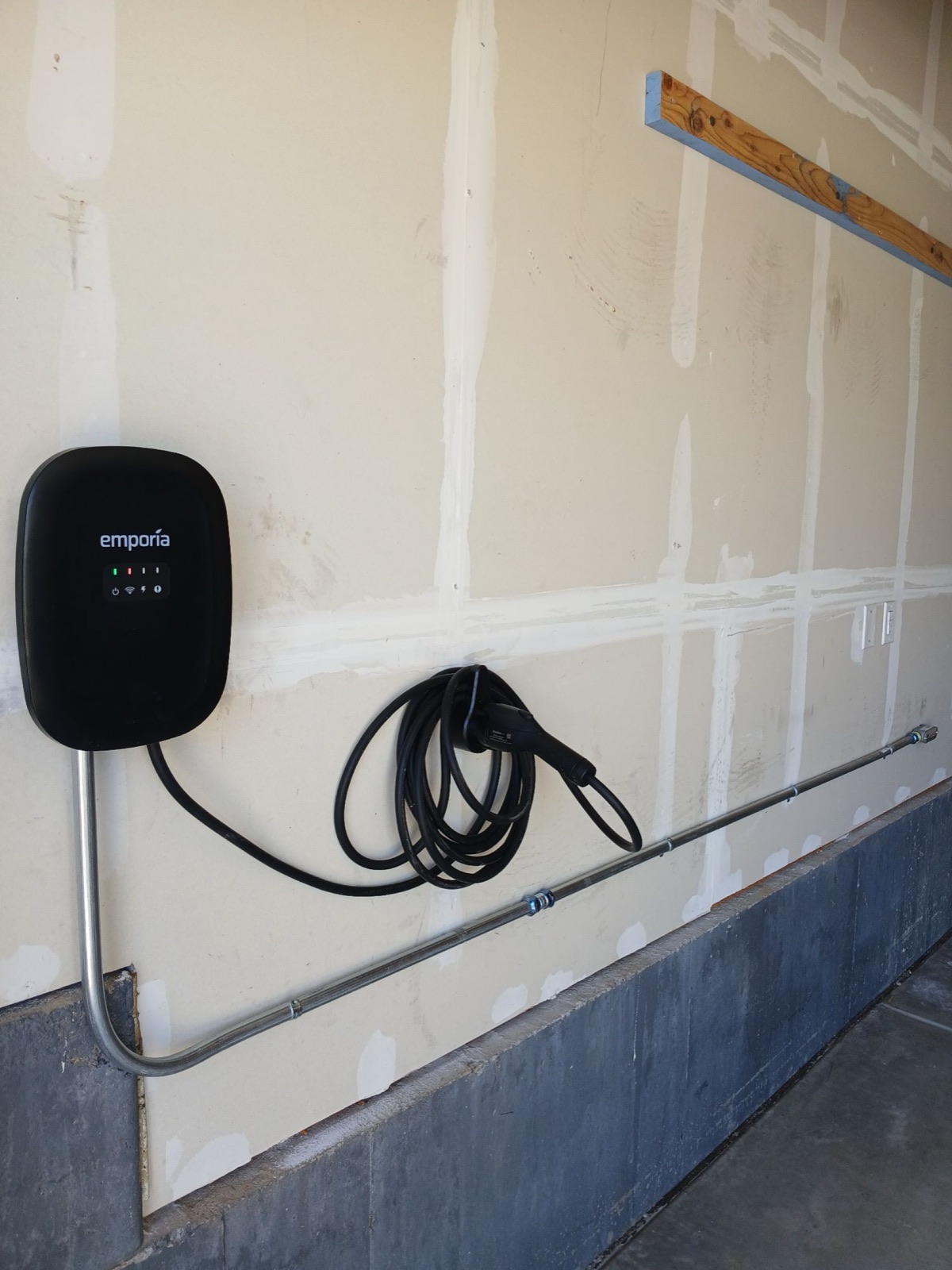
“I always highly recommend the hardwire because then you can fully set the charger to its max capabilities. If you do the plug in style, then you can only set your charger to 42amps because all outlets are only rated up to 50amps max. So you can set the charger for 42amps versus if you hardwire you can set the charger to 48amps.”
— Jon Trujillo, Master Electrician
So that’s 48 amps hardwired vs 42 amps plug-in. Sounds small. Real-world impact is bigger than the number suggests:
“It’s difference of 8amps. So you get 8, 8 additional amps of charging. So 42amps for the plug in version. And then you can get 48amps for the hardwire.”
— Jon Trujillo, Master Electrician
“You’d be surprised on some of the smaller battery vehicles getting that extra amperage to charge a car. You might be saving your charge time down by two hours. So you might wait additionally two hours longer for a plug in version versus the hardwired version.”
— Jon Trujillo, Master Electrician
Eight amps cuts about two hours off a full charge on a smaller battery EV. For someone who plugs in at 10pm and needs the car ready by 6am, those two hours matter.
| Option | Max amperage | Approx. full-charge time difference | Best for |
|---|---|---|---|
| Hardwired install | 48A | Baseline (fastest) | Single-purpose EV charging, dedicated circuit |
| Plug-in (NEMA 14-50) | 42A | ~2 hours longer for smaller-battery EVs | Garage doubles as workshop (welder, heater) |
The one real reason to choose plug-in is garage flexibility:
“Also if there’s a customer that wants to use the outlet for either a garage heater or they might have a welder that they like to use, then I recommend just doing a plug in version. So then at that point you can unplug your charger, you can plug something into that power source and use it like electric garage heater.”
— Jon Trujillo, Master Electrician
Either way, the underlying circuit is the same:
“You always need to have a 240 volt 50amp circuit. So whether it’s a 240 volt 50amps circuit for an outlet to the charger to plug into or whether you hardwire direct to the charger — same thing.”
— Jon Trujillo, Master Electrician
The only thing that changes is whether we terminate at an outlet or directly into the charger.
Which EV charger should I buy — Tesla, ChargePoint, or Wallbox?
Three brands cover 90% of what we install. Jon’s recommendation by car:
“If you have a Tesla then you got to use the Tesla charger. Great charger. If not, then you can go away with the charge point or the wall box.”
— Jon Trujillo, Master Electrician
| Charger | Best for | Approx. hardware cost | Jon’s note |
|---|---|---|---|
| Tesla Wall Connector | Tesla owners | $475 | Required if you have a Tesla. Native NACS, no adapter |
| ChargePoint Home Flex | Non-Tesla EVs | $700 | Solid universal Level 2. WiFi-capable version recommended |
| Wallbox Pulsar Plus | Non-Tesla EVs | $700 | Compact, smart features, WiFi-capable |
The single most important spec — regardless of brand:
“My railways recommendation to a customer is make sure it’s WiFi capable. So then you can sync up to your utility power, know exactly what your usage is. Plus you can schedule off peak charge times.”
— Jon Trujillo, Master Electrician
WiFi-capable chargers let you schedule charging for off-peak Xcel rates, which are meaningfully lower at night:
“With off peak charge times is you pay a lower rate for electricity usage at night versus three to five o’clock during the day. You’re paying a little higher rate through your utility provider. So I always recommend customers to set schedules to charge their car — just pretty much like my cell phone before I go to bed, I plug my cell phone in at night, I let it charge all night so it’s ready to go the next day. The same aspect for a EV vehicle as well. Plug it in at 10pm, let the car charge throughout the night while no other power’s being used in the home and you get the lower peak charges from your utility provider. And by time you get up ready to go, the next day your car’s fully charged, ready to go.”
— Jon Trujillo, Master Electrician
For a deeper comparison, see our Tesla vs ChargePoint guide.
Is a Level 1 (110V) charger enough? Jon’s straight answer.
No. The Level 1 charger that comes in the trunk of every new EV plugs into a standard 120-volt outlet and adds about 4 miles of range per hour. For anyone who actually drives their car, that’s not a charger — it’s an emergency cable.
“No, those you’ll never fully charge your car. So if you use the standard 110 outlet, it might take you a week to let that car charge before you even see a full charge.”
— Jon Trujillo, Master Electrician
“It is that slow. So they are not designed to run off the 110 volt chargers. Really? I really, they shouldn’t even make them. Or offer them with the car in my opinion, because you don’t get any charge whatsoever.”
— Jon Trujillo, Master Electrician
The one nuance worth knowing — the stock cable that comes with most EVs is actually dual-voltage:
“They do the charger that does come with the car, you can pop a pigtail out on it from 120 volt and run it off 240 volt. So the kind of charger that does come with can be universal. I would just not run it with 120 volt outlet.”
— Jon Trujillo, Master Electrician
If you put a 240V outlet in the garage and use the stock cable, you’re getting Level 2 speeds out of the included hardware. We still recommend a dedicated wall-mounted Level 2 charger for permanent installs — but the universal cable is a useful backup for road trips.
Can a normal electrician install an EV charger? What’s required?
Yes — any licensed residential electrician should be capable of an EV charger install if they understand load calculations, dedicated circuits, GFCI requirements, and the local permitting process. The actual install is straightforward; what makes it go wrong is sizing the circuit before confirming the panel can handle it.
The required scope on every job:
- Site visit + load calculation — measure existing draw, add the new 50A charger circuit, confirm the panel total stays under the rated capacity
- Panel evaluation — is the existing panel sized right, or does it need to be upgraded first?
- Permit pulled with the local jurisdiction — Fort Collins, Loveland, Windsor, Greeley, Boulder, and Longmont all run separate building departments
- Dedicated 240V 50A circuit run from panel to charger location
- GFCI protection appropriate to install type (hardwired vs plug-in)
- Heat detector add if you’re in Fort Collins, Longmont, or Broomfield (see next section)
- Final inspection + commissioning — we test the charger before we leave
Most jobs are 4–6 hours on site. Longer if a panel upgrade is wrapped in or if the run goes to a detached garage. We do the load calc the same way Jon does it for panel upgrades and generator sizing — one diagnostic, every future load planned in advance:
“We come meet the customer on site, kind of figure out what their future plans are. If they’re talking hot tubs or are building separate structures of garages on the property. Then we kind of just go over what current amperage they have at the home, discuss their future needs for power and then run a calculation from there to let them know what they’ll need to accommodate all their electrical needs.”
— Jon Trujillo, Master Electrician
Do I need a heat detector in my garage? (Fort Collins + Longmont code)
If you’re in Fort Collins, Longmont, or Broomfield, yes. This is local jurisdiction code, not national NEC — so it catches homeowners off guard, especially when comparing quotes against work done in Loveland or Windsor.
“They’re real particular now that they’re starting to want heat detectors installed in garages. So if you’re looking at getting electrical vehicle charger installed in your garage now we have to do additional work to come off of your smoke detector system and install a heat detector in your garage. So if something was to heat up or catch fire as you’re charging your vehicle, then it’s going to be notifying the household if you had any emergency situations.”
— Jon Trujillo, Master Electrician
The jurisdictions that currently require it:
“Fort Collins does. Longmont area has it. Broomfield areas requiring it.”
— Jon Trujillo, Master Electrician
“It’s not a national electrical code as of yet, but I see that definitely coming in the future.”
— Jon Trujillo, Master Electrician
Loveland does NOT currently require it. Same for Windsor, Greeley, and most of Weld County. That’s a real cost difference — typically $200–$400 in additional labor and materials when we have to tie a new heat detector into the existing smoke alarm circuit. We always factor it into the written quote up front so there are no surprises.
What about Tesla Powershare and Cybertruck whole-home backup?
The Cybertruck’s “Powershare” feature lets the truck back up your home’s power — but with a real ceiling. The truck’s bidirectional output is rated for 48 amps, same as the hardwired Wall Connector. That’s enough to keep lights and a couple of refrigerators running, not enough to back up a whole house with HVAC running.
“We recently just had a customer who wanted to use his — he’s got a Cyber truck and he wanted to back up power through his Cyber truck. And just he, in his mind he thought he could back the whole entire house up. Well, your charger, same thing, it’s only rated for 48amps. So you’re going to be able to run 48amps back from your Tesla truck back to your house. So 48amps isn’t getting you a whole lot of backup power other than running your lights, couple refrigerators, and then you’re going to be meeting that 48amps need.”
— Jon Trujillo, Master Electrician
What we ended up doing for that customer:
“So what we ended up doing was installing a couple power walls on his home as well. So then he could get, he could actually back up the entire house with power. With the power walls installed.”
— Jon Trujillo, Master Electrician
If whole-home backup is the goal, the Powerwall does the heavy lifting and the Cybertruck’s Powershare extends the runtime. For details on Powerwall installs and where we mount them, see our Tesla Powerwall page.
Last reviewed by a Master Electrician: April 29, 2026.
Have a question about your specific EV charger install? Call (970) 645-3114 for a free estimate. We’ll come to your home, run the load calculation, confirm whether your panel can handle the new circuit, and put a written number on paper — no pressure, no commission-driven upsell.