





A 100-amp to 200-amp service upgrade in Northern Colorado typically runs $2,000–$5,000 — meter base, mast/riser, service entrance conductors, main breaker, grounding, and Xcel coordination included. Service upgrade ≠ panel upgrade: this covers everything upstream of your panel (the wires from the utility transformer to your meter to your main breaker). Power is off 4–6 hours while we swap the meter base and the utility reconnects. Required prerequisite for most EV chargers, heat pumps, hot tubs, and home additions.
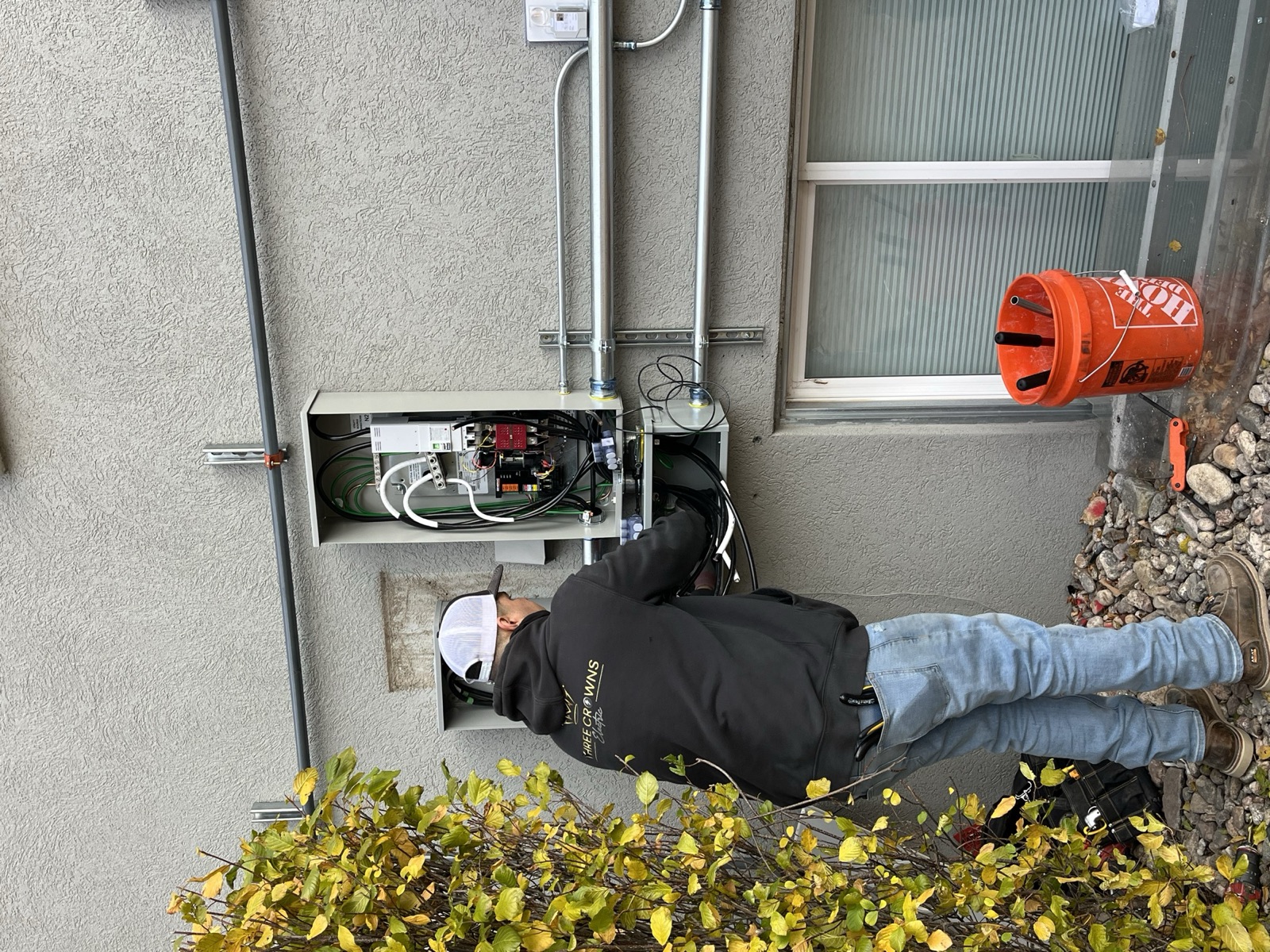
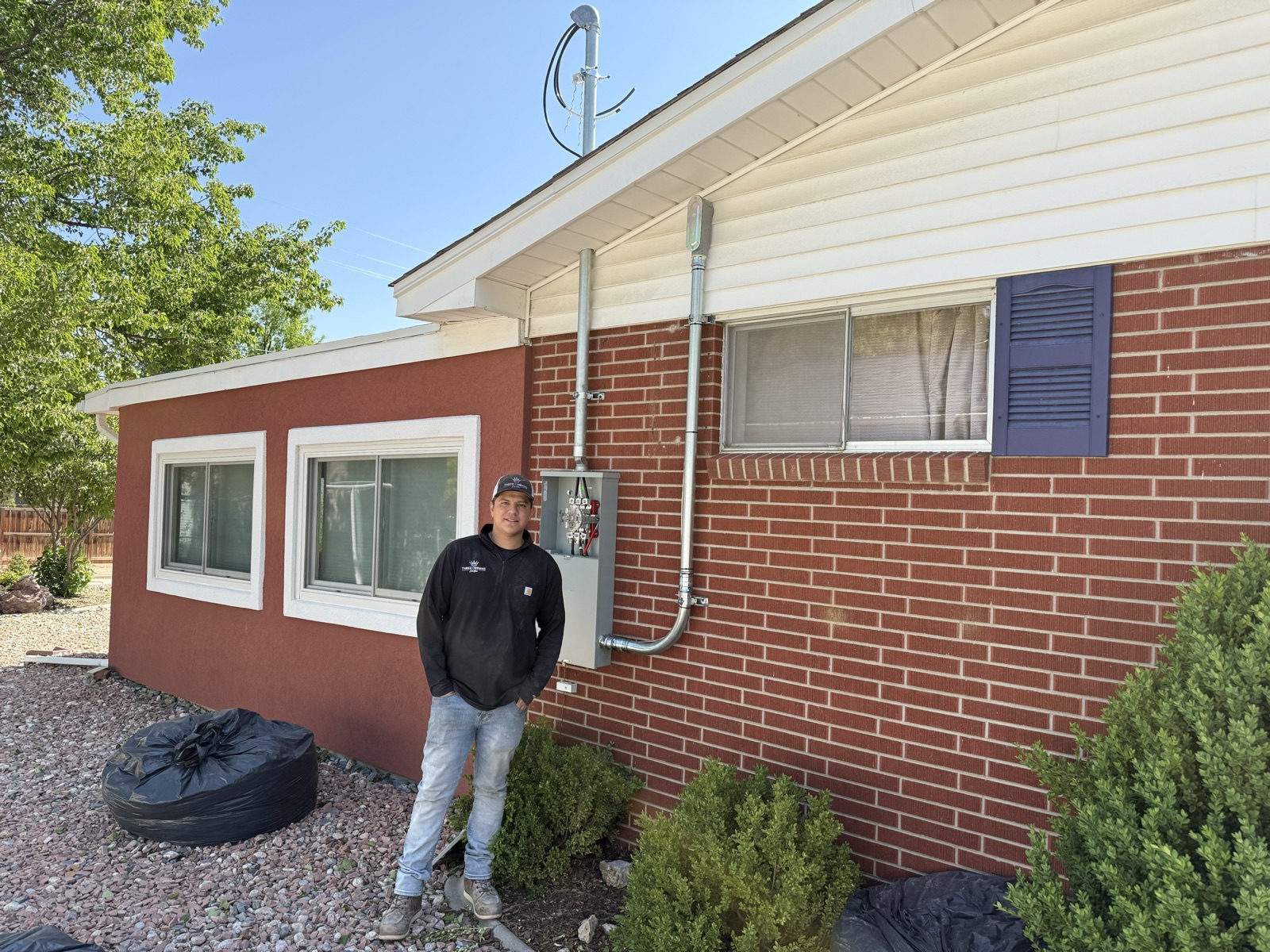
When another contractor tells you “you need a 200-amp service before we can install your EV charger,” they’re talking about a service upgrade — not a panel upgrade. The two get conflated all the time, and the difference matters because the scope is different and the price is different. A panel upgrade is the breaker box inside the wall. A service upgrade is everything between the utility transformer and that breaker box: the wires up to the meter, the meter base on the outside of your house, the riser/mast going through the eave, the conductors running into your panel, and the coordination with Xcel (or your local co-op) to physically disconnect and reconnect your drop.
What follows is what a 200-amp service upgrade actually costs in Northern Colorado, what’s involved, and how to know whether you need one or whether a panel upgrade alone is enough.
Service upgrade vs panel upgrade — what’s the difference?
These get conflated constantly. The clearest way to keep them straight:
| Panel upgrade | Service upgrade | |
|---|---|---|
| What changes | The breaker box inside the wall | The breaker box + everything upstream of it |
| Scope | Internal — drywall stays, panel swap, breakers reseated | External + internal — meter base, riser, service conductors, panel |
| Utility involvement | None — main breaker stays the same amperage | Xcel disconnect + reconnect required |
| Power off window | 1–2 hours typical | 4–6 hours typical |
| Typical cost (NoCo) | $1,500–$4,500 | $2,000–$5,000 |
| What it enables | More circuits, modern breakers (AFCI/GFCI), surge protection | Higher total amperage to the home (e.g., 100A → 200A) |
| When you need it | Old/recalled panel (FPE, Zinsco, Challenger), insufficient breaker slots | Total service amperage is undersized for the house’s loads |
The simplest test: if a contractor’s quote says “200-amp upgrade” and the price is $1,500, that’s a panel upgrade — they’re swapping the breaker box but leaving the rest of your service alone. If the same quote says “200-amp upgrade” and the price is $3,500, that’s a service upgrade — they’re touching the meter base too.
For homes that already have 200-amp service but a recalled Federal Pacific or Zinsco panel, the right job is a panel upgrade alone. For homes that have 100-amp service and need to run a 50A EV charger circuit, the right job is a service upgrade.
How much does a 200-amp service upgrade cost in Northern Colorado?
A typical 100-amp to 200-amp service upgrade runs $2,000 to $5,000 in Northern Colorado, with most jobs landing around $3,500 fully installed. The price depends on five things: whether the meter base needs full replacement (almost always), whether the utility requires a new mast/riser through the eave, the length and condition of the service entrance conductors, whether the panel itself also needs to be upgraded as part of the job, and whether your jurisdiction requires any additional inspections beyond the standard final.
| Scenario | Approx. cost | Notes |
|---|---|---|
| 100A → 200A standard upgrade (existing meter location, intact mast) | $2,000–$2,800 | Meter base + service conductors + panel breaker |
| 100A → 200A + full mast replacement | $2,800–$3,800 | Older homes with a deteriorated mast |
| 60A → 200A (rare but real on 1950s homes) | $3,500–$5,000 | Full service overhaul, sometimes new drop required |
| 200A → 320A residential service upgrade | $5,000–$8,000 | Larger meter base, heavier feeder, prior Xcel approval required |
We don’t quote service upgrades over the phone. The variables matter — the meter location, the mast condition, whether the panel is wrapped into the same job — and we’d rather come look at the actual house than guess. The quote is free; the truck rolls within 48 hours of your first call.
What’s involved in upgrading to 200-amp service?
The full scope, in order:
- Site visit + load calculation — we measure your existing draw, add the new loads you’re planning (EV, heat pump, hot tub, etc.), and confirm 200A is the right size (sometimes 320A is the right answer)
- Xcel coordination paperwork — we submit the upgrade application, get the meter pull scheduled, and line up the inspector
- Permit pulled with your jurisdiction (Fort Collins, Loveland, Windsor, Greeley, Boulder all run separate departments)
- Day-of: utility disconnect — Xcel pulls the meter and disconnects the drop at the transformer
- Meter base replacement — old 100A socket comes off, new 200A socket goes on the same wall
- Mast/riser inspection or replacement — the conduit and weatherhead going up through the eave; sometimes original is fine, sometimes needs replacement
- Service entrance conductors — the wires from meter to panel get upsized to 200A-rated cable
- Main breaker swap or panel upgrade — depends on whether the panel itself is being upgraded too
- Grounding system update — code requires a 200A service to have specific grounding (rod, water bond, GES) verified
- Inspector signs off
- Xcel reconnects — meter back in, drop re-energized, power restored
Most jobs are 4–6 hours from “lights off” to “lights back on.” We schedule for weekday mornings so you’re back on by early afternoon with plenty of time for the fridge to recover before dinner.
Do I need a 200-amp service for an EV charger, hot tub, or heat pump?
Sometimes. Not always. The answer depends on what else is running in the house.
A 100-amp service can comfortably handle:
- Gas furnace + gas water heater + gas range
- One AC unit (3-ton or smaller)
- Standard kitchen appliances
- One Level 2 EV charger (40A) only if everything else is gas
A 100-amp service usually CANNOT handle:
- Heat pump (electric heat) + Level 2 EV charger
- Electric range + electric water heater + heat pump + EV charger
- Hot tub + EV charger + central AC
- Any combination of two high-draw electric loads on top of an already-busy panel
The honest test isn’t “do I have room in my panel?” It’s “what’s my actual draw at peak?” We do the same load calculation we use for panel upgrades, EV charger installs, and generator sizing — measure the existing draw on a meter, add the new loads, see if 100A still works.
About half the time we measure, the answer is yes — the 100A service still has headroom and the homeowner can install the new circuit on the existing service. About half the time, the math doesn’t work and the right call is to upgrade to 200A. We tell you which side of the math your house is on, with the actual numbers on paper.
For homes adding two EV chargers or shop equipment (welders, air compressors, large dust collectors), the answer is almost always 200A — and sometimes 320A residential service.
Who coordinates the disconnect with Xcel (or my local co-op)?
We do. You don’t make any phone calls.
Xcel Energy (and the local co-ops in Estes Park, Wellington’s edges, and parts of Boulder County) handle the physical disconnect and reconnect at the drop. They send a tech with a bucket truck to pull the meter on the morning of the upgrade and another to put it back when the inspector signs off. They don’t do the meter base replacement or any of the inside work — that’s us.
What we file:
- The service upgrade application with Xcel (or co-op)
- The local permit with your city/county building department
- The inspection request after we finish the work
- The reconnect request with Xcel after the inspector signs
You sign two things — the original application and the final paperwork — and that’s it. No coordination calls. No “wait, who’s responsible for what?” confusion. We’ve done close to 1,000 of these and Xcel knows our company by phone.
How long will my power be off?
Typically 4–6 hours. The schedule looks like:
- 8:00 am — Xcel arrives, pulls the meter, disconnects the drop
- 8:30 am – 12:30 pm — we swap the meter base, replace mast/riser as needed, run new service entrance conductors, upgrade the panel breaker (or full panel if scoped), update grounding
- 12:30 pm – 1:30 pm — inspector arrives, signs off
- 1:30 pm – 2:00 pm — Xcel returns, reconnects the drop, re-energizes the meter
- 2:00 pm — power restored
We schedule for weekday mornings deliberately. Working from home? Schedule a coffee shop morning. Have a freezer of meat? We tell you on the first call so you can plan ice or borrow a neighbor’s space. Have medical equipment that can’t lose power? We coordinate with you in advance and sometimes recommend installing a backup generator before the upgrade so the day-of is seamless.
Is upgrading to 200-amp service worth it?
For most NoCo homes adding modern electric loads, yes. The math is straightforward — the upgrade itself is $2,000–$5,000 one-time, and it eliminates an entire category of problems for the next 30+ years. Specifically, it lets you:
- Install a Level 2 EV charger without conflict with other loads
- Add a heat pump for AC + heating in one efficient unit
- Run a hot tub on a dedicated 50A circuit
- Add an addition or ADU without redoing the service later
- Pass insurance underwriting (some carriers flag undersized service)
- Run a future home backup generator at appropriate scale
- Add a Tesla Powerwall or similar battery system
The cases where it ISN’T worth it: small homes with no plans to add electric loads, gas-heated homes where the existing 100A is comfortably under the rated capacity, and rentals where the owner won’t recapture the upgrade cost. We tell you straight if your situation falls into one of those buckets.
Do you pull the permits and coordinate the inspection?
Yes. Every service upgrade includes the permit, the utility paperwork, and the final inspection coordination. You don’t make any phone calls.
We pull the permit with your local building department (different per town — Fort Collins, Loveland, Windsor, Greeley, and Boulder all have their own offices). We schedule the disconnect and reconnect with Xcel Energy. We’re on-site for the inspection, which usually happens during the 4–6 hour window so we can hand off cleanly to the utility for reconnection.
The 2-year written warranty on the work covers parts and labor. The work also passes inspection — and a clean inspection is part of why we have that warranty. If it didn’t pass, we wouldn’t write the warranty.
Last reviewed by a Master Electrician: April 29, 2026.
Have a question about your specific service upgrade? Call (970) 645-3114 for a free estimate. We’ll come to your home, measure your actual draw, look at your meter base and mast, and put a written number on paper — no pressure, no scope creep, no surprise bills.