





Commercial electrical panel installation and upgrades in Northern Colorado typically run $3,000–$15,000+ depending on amperage, single-phase vs three-phase, and whether the utility has to re-feed the service. We install 200A single-phase up through 800A three-phase main switchgear plus distribution panels and sub-panels. Most of our commercial volume is tenant finish — retail, restaurants, dental/medical offices, and warehouse expansion. We coordinate Xcel utility paperwork, pull permits, and work to your GC’s schedule (including nights and weekends) so the certificate of occupancy doesn’t slip.
Commercial panels are a different world than residential. Three-phase power, bigger breakers, stricter coordination with the utility, and an inspector who’s reading the service load calculation line by line. Get it wrong and the building doesn’t get its certificate of occupancy. We’ve done enough tenant finishes, warehouse expansions, and medical office upgrades across Northern Colorado to know how each jurisdiction reads the code — and which inspectors will reject a tap-and-splice that’s perfectly fine in residential.
We’re a licensed electrical contractor doing both residential and commercial work, with about 40% of our revenue coming from commercial. Most of that is tenant finish — restaurants, retail buildouts, dental offices, medical practices, light industrial — coordinated with a GC and the property owner.
What does a commercial electrical contractor do? (vs residential)
The difference comes down to scale, code, and coordination:
| Dimension | Residential | Commercial |
|---|---|---|
| Service | Single-phase, 100A–320A typical | Three-phase, 200A–800A typical (industrial up to 4,000A+) |
| Wiring method | Romex (NM-B) cable in walls | EMT conduit, MC cable, or rigid conduit (NEC prohibits Romex in commercial) |
| Panel type | Breaker box (residential load center) | Panelboard with bolt-in breakers (NEMA-rated) |
| Code complexity | NEC residential articles | NEC commercial + ADA + local commercial code overlays |
| Inspection | Single inspector, 1–2 visits | Multiple inspections (rough, panel, devices, fire) |
| Utility coordination | Standard Xcel meter pull | Often involves load study, transformer re-feed, coordination study |
| Schedule pressure | Homeowner-flexible | CO date is fixed — every day late costs the tenant rent |
| GC coordination | Sometimes | Always — we work the GC’s master schedule |
The meta-skill of commercial electrical work isn’t the hardware — it’s schedule reliability. Any licensed electrician can install a panelboard. The contractor who can hit a 6-week tenant finish without a single inspection failure or schedule slip is the contractor who keeps getting hired.
What size commercial panels and switchgear do you install?
Everything from 200A single-phase up through 800A three-phase main switchgear plus distribution panels and sub-panels. Above 800A, we partner with a switchgear specialist we trust — that’s industrial scale where a dedicated sub makes sense.
| Service size | Typical use case | Common scope |
|---|---|---|
| 200A single-phase 120/240V | Small retail, dental office, single-tenant building | Main breaker panel + ~10–20 circuits |
| 400A single-phase 120/240V | Restaurant, larger retail, mid-size office | Service entrance + main + sub-panels |
| 200A three-phase 208Y/120V | Restaurant with commercial kitchen, light industrial | Three-phase main + lighting + power distribution |
| 400A three-phase 208Y/120V | Mid-size warehouse, multi-tenant, larger restaurant | Main switchgear + multiple sub-panels |
| 600A–800A three-phase | Large warehouse, manufacturing, multi-tenant complex | Main switchgear + extensive distribution |
| 1,000A+ three-phase | Industrial / large institutional | We partner with switchgear specialist |
Tell us the facility type, square footage, and equipment list and we’ll tell you what you actually need. Most commercial buyers under-spec the panel because the equipment list grows during the project — we recommend sizing for 25–30% future capacity on every install.
Do you work directly with my general contractor on tenant finish?
Yes — that’s our preference on most commercial work. Tenant finish is our biggest commercial vertical and we’ve worked with most NoCo GCs running build-outs in Fort Collins, Loveland, and Boulder.
The standard workflow:
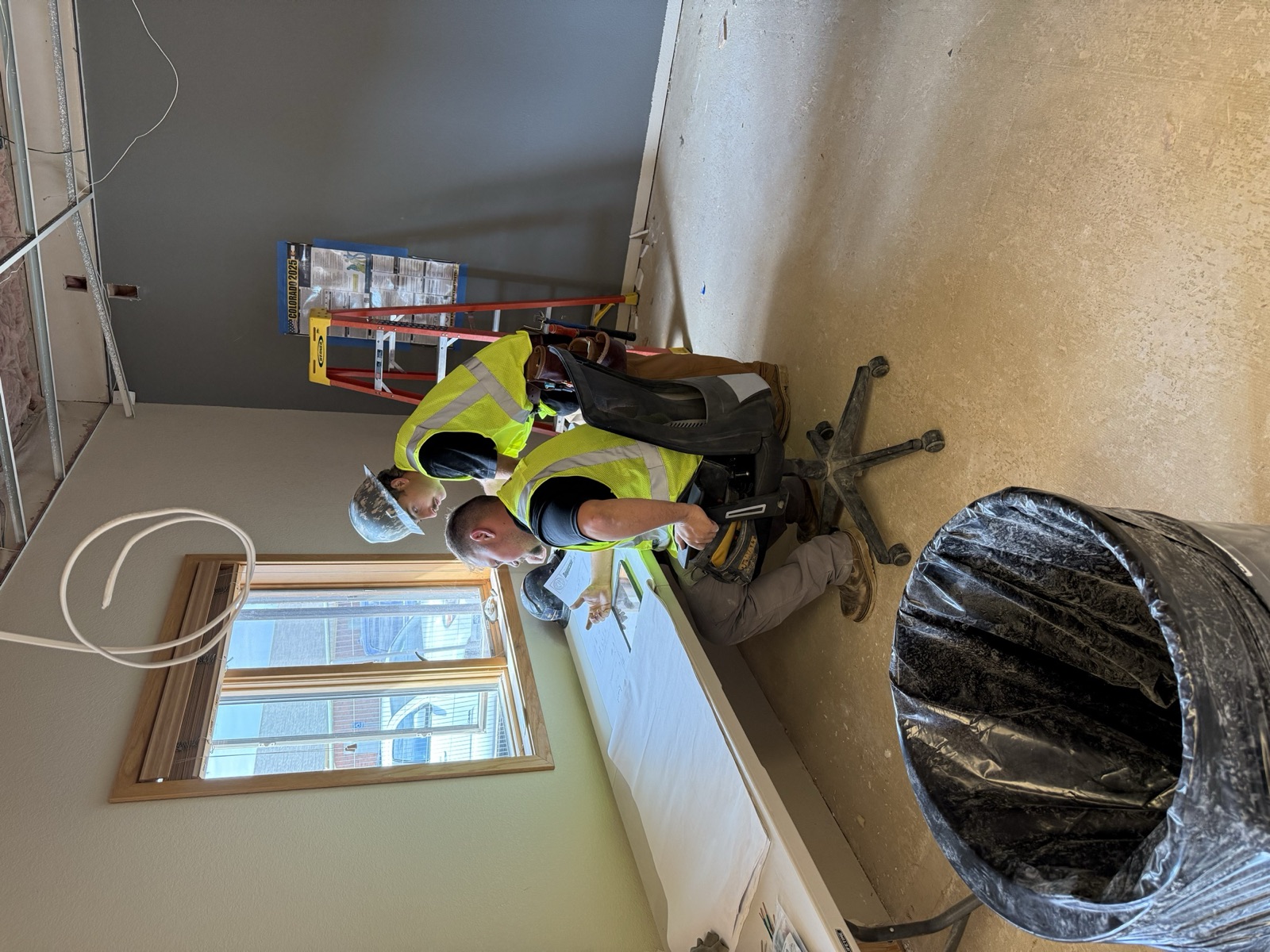
- Pre-construction meeting — we attend with the GC, plumbing, HVAC, and fire to scope coordination
- Permit submission — we pull the electrical permit; GC pulls the master permit
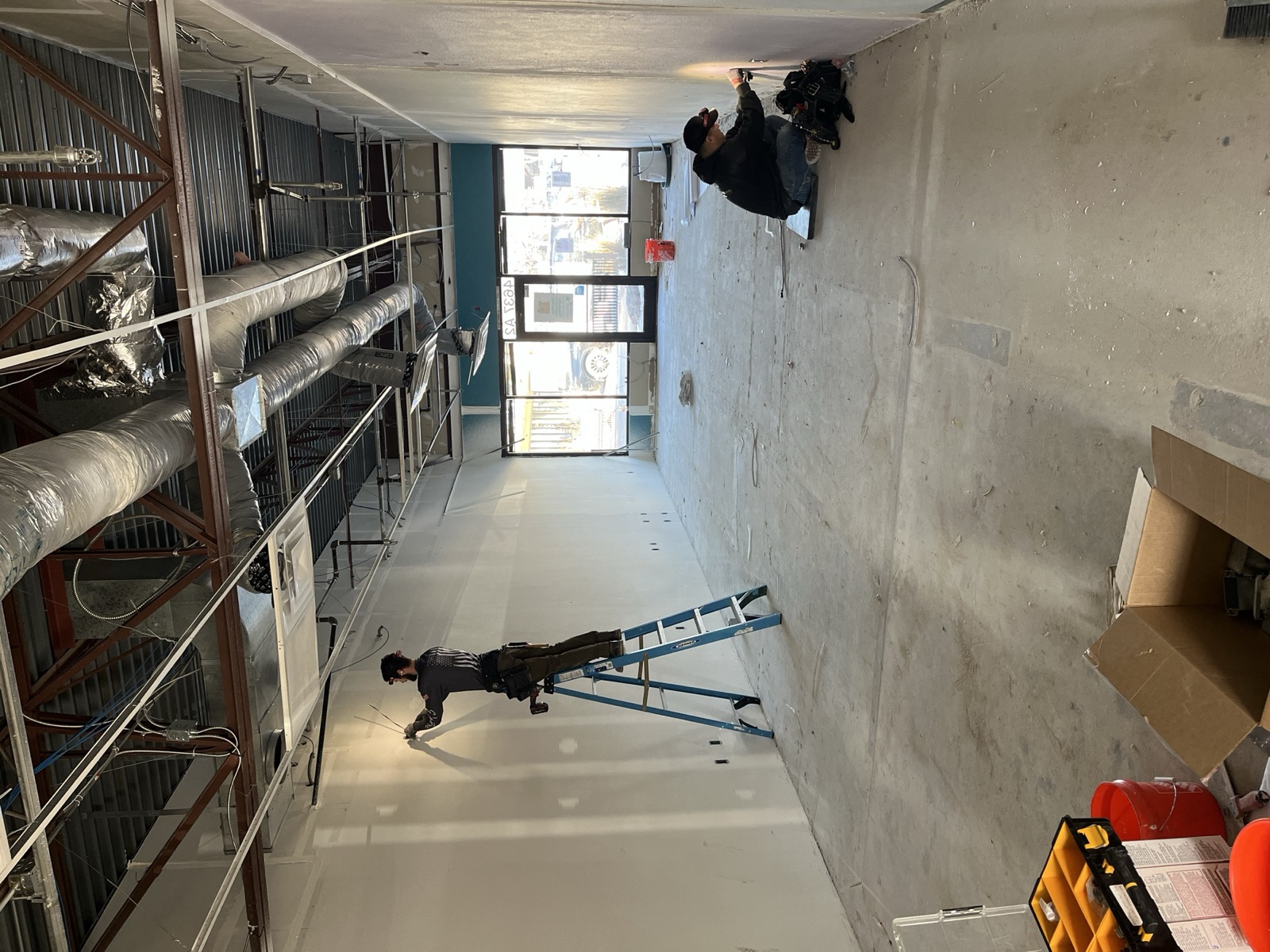
- Rough-in — pull wire, set boxes, install panel, prep for rough-in inspection
- Rough-in inspection — typically before drywall + ceiling close-up
- Trim-out — devices, fixtures, panel finish, GFCI testing, low-voltage termination
- Final inspection — we’re on-site for the inspector walk-through
- Certificate of Occupancy — meter goes live, tenant moves in
For property owners running the project directly without a GC, we treat them the same as a GC — same coordination, same milestones, same accountability for our scope’s piece of the schedule. Owner-operators sometimes do better than GC-run projects because there’s less hand-off coordination required.
How do you coordinate with Xcel on transformer re-feeds and load studies?
Commercial utility coordination is the part of the job most homeowners (and many residential electricians) don’t anticipate. Three things that come up on commercial scope:
Load study: Xcel may require a formal load calculation showing your facility’s planned electrical demand before they’ll authorize a service upgrade. We prepare and submit the load study, including HVAC loads, motor starting current, demand factors, and any specialty equipment.
Transformer re-feed: Going from 200A single-phase to 400A three-phase often means Xcel has to upgrade or replace the pad-mount transformer that feeds your building. The transformer upgrade can take 4–12 weeks to schedule, and Xcel does the work — we file the application and coordinate timing.
Coordination study: For larger services (600A+) or facilities with critical equipment, the AHJ or insurance carrier may require an arc-flash coordination study — an engineering analysis of how breakers respond to faults at every panel level. We coordinate this with a P.E. (professional engineer) and integrate the recommendations into the install.
We file the paperwork. We schedule the disconnects. We keep the utility timeline aligned with your build schedule. The GC owns the master timeline; we own keeping Xcel from being the reason it slips.
Can you work nights or weekends to keep my building open?
Yes — this is one of the biggest reasons commercial customers hire us. About 40% of our commercial work happens outside normal business hours. Common scenarios:
- Restaurant panel upgrade — done overnight Sunday-to-Monday so the restaurant doesn’t close
- Retail tenant finish trim-out — weekend work to hit Monday CO date
- Medical office equipment add — Saturday work to avoid disrupting patient hours
- Warehouse maintenance — Sunday work to avoid disrupting shift production
After-hours and weekend rates run roughly 1.3–1.5× our standard commercial rate. We quote them upfront so there are no surprises. The math almost always works out for the customer — a $2,000 after-hours premium beats $30,000 of lost weekday revenue from a closed restaurant.
For genuine emergencies (a tripped main on a Saturday night that’s risking refrigerated inventory or HVAC during a heat wave), see our emergency electrician page — we cover commercial emergencies on the same 2-hour response window as residential.
How much does a commercial panel upgrade or new service cost?
A typical commercial panel upgrade runs $3,000 to $15,000+ in Northern Colorado. The price moves with eight things: amperage, single-phase vs three-phase, whether the utility has to re-feed, distribution panel count, conduit type and length, code-required arc-flash labeling, after-hours premium, and inspection scope.
| Project type | Typical cost | Notes |
|---|---|---|
| 200A single-phase tenant finish (small retail, office) | $3,000–$5,500 | Main panel + 10–20 circuits |
| 400A single-phase upgrade (restaurant, larger office) | $5,500–$9,000 | Main + sub-panels |
| 200A three-phase new service (restaurant, light industrial) | $6,000–$10,000 | Includes Xcel re-feed if required |
| 400A three-phase main switchgear + distribution | $8,500–$15,000 | Mid-size warehouse, multi-tenant |
| 600A–800A three-phase | $12,000–$22,000+ | Larger facility, full distribution |
| Tenant finish electrical (typical 2,000–5,000 sqft retail/office) | $8,000–$25,000+ | Includes lighting, devices, panel |
We quote the whole scope — panel, breakers, feeder, labor, permit, inspection, utility coordination — as a single itemized number. No hourly billing on commercial scope unless explicitly negotiated for service contracts.
Do commercial electrical panels have to be locked or labeled per code?
The 2023 NEC has specific labeling and access requirements for commercial panels:
- Working clearance: 30” wide × 36” deep × 6.5’ tall clear in front of every panel (no shelves, no obstructions)
- Arc-flash labeling: every panel labeled with arc-flash hazard rating and required PPE
- Circuit directory: every breaker labeled clearly identifying what it controls (not “lights” — “front of house lights, dining room”)
- Service entrance label: main service labeled with available fault current
- Working clearance markings: floor markings indicating the required clearance zone
Locking requirements depend on the panel location and the AHJ. Panels in tenant-accessible areas (back of restaurant, retail employee area) are not required to be locked but typically should be. Panels in public areas (in a hallway, on a wall facing the public) are required to be locked or behind locked doors. Panels in dedicated electrical rooms don’t require individual locks but the room itself should be locked.
We handle the labeling, working clearance verification, and lock installation as part of every commercial install. The inspector checks all four — we don’t want any of these to be the reason the CO inspection fails.
For commercial power distribution beyond the main panel — switchgear, panelboards, multi-tenant metering — see our commercial power distribution page.
Last reviewed by a Master Electrician: April 29, 2026.
Have a commercial project coming up? Call (970) 645-3114 for a job-walk and quote. We’ll meet you on site, walk the scope with your GC if applicable, file the Xcel paperwork, and put a written quote on paper before any wire gets pulled.