





Hot tub wiring in Northern Colorado typically runs $500–$2,000 for a code-compliant install with a dedicated 240V circuit, GFCI disconnect, and bonding. Most suburban jobs land around $1,000–$1,400 including the GFCI disconnect. The NEC requires the disconnect to be within sight of the tub but at least 5 feet from the edge of the water. Hot tubs are one of the top three reasons we recommend a panel upgrade — a 40A or 50A tub circuit on top of an already-busy 100A panel often pushes the math past code. We coordinate with the hot tub delivery company so you’re not stuck with a tub on a pad and no power.
Hot tubs, spas, and in-ground pools all have strict NEC code requirements — distance from the water for the disconnect, GFCI protection on the circuit, bonding for every piece of metal that could become energized, and proper conductor sizing for 40A or 50A loads. The hot tub dealer sells you the tub. The electrical is on you, and they don’t help once the truck leaves. We make sure it’s wired right the first time so the inspector signs off and the tub actually runs the day it’s filled.
What follows is the actual install cost in Northern Colorado, the NEC rules that catch most homeowners off guard, and the panel-upgrade conversation that comes up about half the time on hot tub jobs.
How much does hot tub wiring cost in Northern Colorado?
A typical hot tub wiring job runs $500 to $2,000 with most suburban installs landing around $1,000–$1,400. The price depends on five things: the distance from your electrical panel to the tub pad, whether your panel has a free breaker slot for the new 50A circuit, whether the wire run is underground / through finished wall / exterior conduit, whether the existing service can take the new load, and whether the tub comes with a built-in disconnect or whether we add an external one.
| Scenario | Approx. cost | Notes |
|---|---|---|
| Standard install (panel slot free, ≤30ft exterior run, surface conduit) | $800–$1,200 | Most common pattern |
| Standard install with finished-wall fishing | $1,200–$1,600 | Some drywall access required |
| Underground conduit run (>30 ft to back yard) | $1,400–$2,000 | Trenching adds time |
| Install + sub-panel installation | $1,800–$2,500 | When main panel slot is unavailable |
| Hot tub install + panel upgrade required | $3,500–$6,500 | Panel upgrade quoted same time |
We don’t quote hot tub wiring over the phone. The variables matter — your panel layout, the tub spec sheet, the route from panel to pad — and the only honest way is a site visit. The quote is free.
What does the NEC require for a hot tub circuit?
The National Electrical Code has very specific rules for hot tubs because of the obvious risk: 240V circuits running close to a body of water. The four hard requirements:
- Dedicated 240V circuit — typically 40A or 50A, sized to the tub’s spec sheet (most North American hot tubs are 40A or 50A)
- GFCI protection — either at the breaker (for residential systems) or at an external disconnect
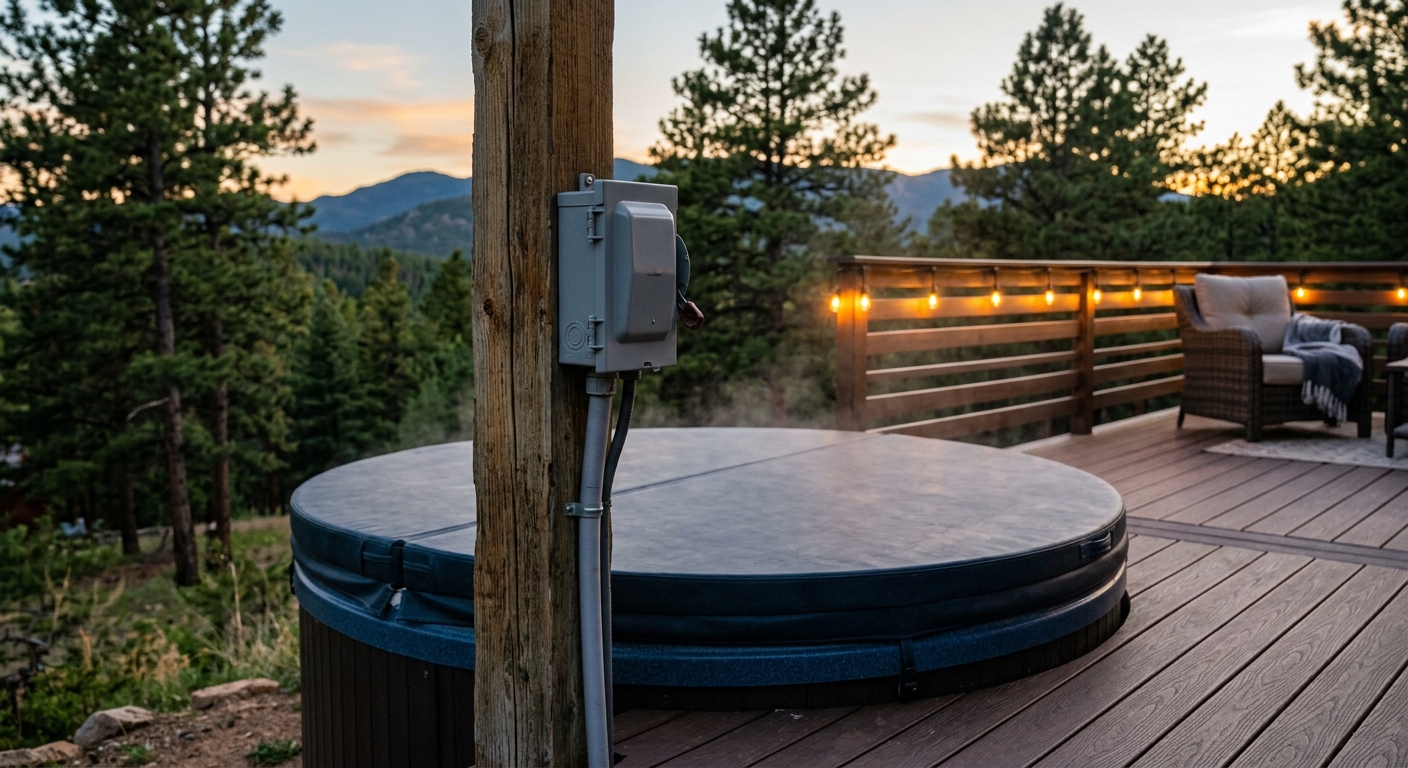
- Disconnect location — within sight of the tub but at least 5 feet from the edge of the water, and never above or behind the tub
- Equipotential bonding — every metal component associated with the tub (pump motor, heater, ladder, deck reinforcement near the tub) has to be bonded together with a #8 AWG copper conductor to prevent voltage differential between any two pieces of metal someone could touch
The bonding rule is the one that catches DIY installs the most often. Inspectors check it specifically — they want to see the bonding lug on the pump motor connected by visible #8 copper to the tub’s bonding grid, and the grid bonded to the home’s grounding electrode system.
The 5-foot rule is the second most common failure point. We’ve seen DIY installs with the disconnect mounted right next to the tub (convenient for the homeowner) and watched the inspector reject it on the spot. We mount the disconnect on an exterior wall or post within sight of the tub at the required distance — typically 5–8 feet away.
Do I need an electrician to wire my hot tub?
Yes, in every Northern Colorado town we serve. Three reasons:
- The work requires a permit — and the permit application has to be signed by a licensed electrical contractor in every NoCo jurisdiction (Fort Collins, Loveland, Windsor, Greeley, Boulder, Longmont, Wellington, etc.)
- The inspector will check — and an unpermitted hot tub installation can void your homeowner’s insurance, fail the home inspection at sale time, and create a real liability if anyone gets hurt
- The mistakes are silent — wrong wire gauge, missing bonding, GFCI in the wrong location: none of these prevent the tub from running. They just create the risk that catches up with you the first time something goes wrong
Hot tub manufacturers (Jacuzzi, Hot Spring, Master Spas, Caldera, Sundance, Cal Spas) all explicitly require professional electrical install in their warranty terms. DIY wiring voids the tub’s electrical warranty.
The cost difference between a permitted, code-compliant install and a DIY install is usually $400–$800. The cost of an inspector failing the install and requiring rework is $1,200–$2,000. The cost of an undetected wiring fault that damages the tub or causes injury is much higher.
Where does the GFCI disconnect have to go?
Within sight of the tub but at least 5 feet from the edge of the water. This is the rule that creates the most homeowner confusion because the convenient mounting location (right by the tub) is the one location code prohibits.
The exact NEC requirement (Article 680.13 and 680.42):
- Within sight of the tub — the disconnect has to be visible from the tub itself (not behind a wall, not around a corner)
- Minimum 5 feet horizontal distance from the inside wall of the tub
- Not above the tub or directly behind it — accessibility from outside the splash zone matters for emergency shutoff
- Outdoor-rated enclosure (NEMA 3R or better) for any outdoor mount
- GFCI-protected — either at the breaker or at the disconnect itself
We mount disconnects on the back wall of the home (within sight of the tub on the patio), on a 4×4 post next to the tub pad, or on the side of a deck-rail fence panel. The exact location depends on your tub orientation and the building geometry — we walk it on the site visit and recommend the cleanest spot that meets code.
My tub is 40A or 50A — will my existing panel handle it?
Depends on what else is running. A 40A or 50A dedicated circuit is a big load — it’s roughly equivalent to running a second electric range. On a 200A service with available capacity, it’s straightforward. On a 100A service that’s already running an AC unit, an electric water heater, or a heat pump, the math often doesn’t work.
We do the same load calculation we use for panel upgrades, EV charger installs, and generator sizing. Measure existing draw, add the new tub circuit, see if the total stays under your service rating with code-required headroom.
About half our hot tub jobs add a panel upgrade conversation to the quote:
- Service is 200A with headroom: install proceeds straight, $1,000–$1,400 typical
- Service is 200A but the panel is full: sub-panel install added (~$1,500–$2,500 over the wiring)
- Service is 100A and barely has headroom: we tell you straight that 100A → 200A upgrade is the right call before the tub runs ($2,000–$3,500 added) — see our service upgrades page
- Service is 100A with no headroom: panel upgrade required, quoted in the same proposal
We tell you both numbers up front so you can make one decision instead of getting surprised mid-install.
Can the wiring run through a finished wall, or does it have to go outside?
Either works, and the right answer depends on your specific home and how much drywall patching you want to deal with.
Through finished wall (interior):
- Cleaner final look — no visible conduit
- Requires drywall access points (typically 2–4 small cuts, patched after)
- Slightly higher labor cost for the fishing
- Common when the panel is on an interior wall and the tub is on the back of the same wall
Through exterior conduit:
- Faster install, lower labor cost
- Visible conduit on the wall (paintable to match siding)
- No drywall to open or patch
- Common when panel is on a different wall than the tub or there’s an attic gap to bridge
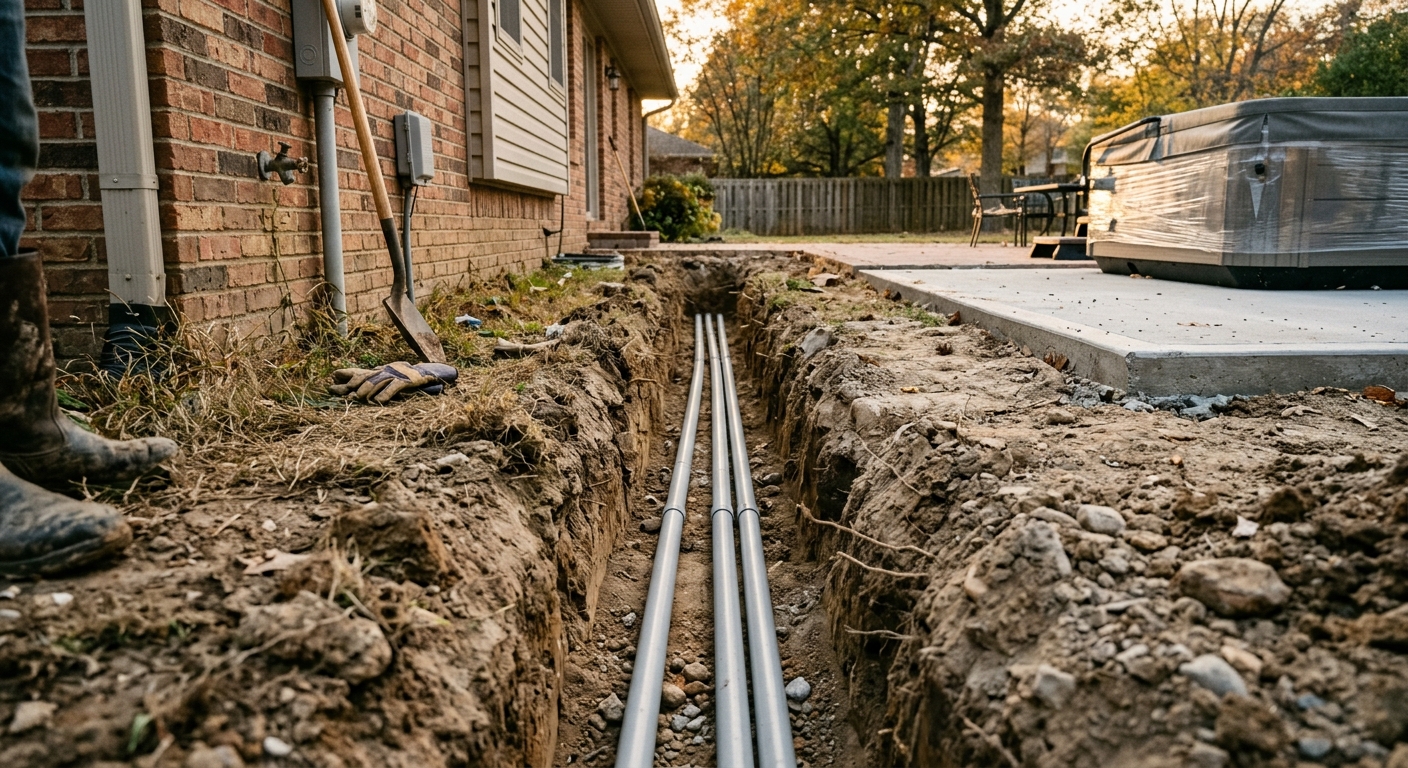
Underground:
- Required when the tub pad is detached from the home or far from the panel
- Direct-bury 6/3 UF cable or rigid conduit at code-required depth
- Adds trenching time but keeps the run protected
- Most common for back-yard tub installs in older homes
We walk your specific situation on the site visit and recommend the cleanest route. We’ll also tell you up front if drywall patching will be needed and how much.
Do you coordinate with the hot tub delivery company?
Yes — we prefer to. The single most common bad experience homeowners have with hot tub installs is that the delivery company drops the tub on a pad with no power waiting, the install gets delayed, and the homeowner ends up with an empty tub for a week while we sort out the circuit.
We get ahead of that. The standard sequence:
- Tub purchase confirmed — homeowner gets a delivery date from the dealer
- We come out a week or two before delivery — site visit, design the circuit, pull the permit
- We install the circuit + disconnect before the tub arrives
- Tub gets delivered to a pad with power already there and disconnect waiting
- Tub install day — the tub company does the plumbing/water connection; we do the final 30-minute electrical connection from disconnect to tub control box
- Tub fills + runs
If the timing slips and the tub arrives before we’re done, we can usually catch up within 24–48 hours of delivery. But the “everything ready before the tub shows up” sequence is the smoothest experience for everyone.
We’ve worked with most NoCo hot tub dealers — Olympic Hot Tub, Mountain Hot Tubs, Bell Pool Spa, and the Costco / Sam’s Club delivery teams that come through. Tell us your dealer when you call and we’ll likely have already wired a job for them.
What about pool, spa, and sauna wiring — same code rules?
Mostly yes, with some specifics:
| Equipment | Circuit | Disconnect rule | Bonding |
|---|---|---|---|
| Hot tub / spa (240V) | 40A or 50A 240V GFCI | 5 ft from water, within sight | Equipotential grid + #8 AWG to GES |
| In-ground pool | Pump 20A 240V GFCI, heater 30–60A | 5 ft from water, within sight | Full equipotential grid (pool shell, deck rebar, ladders, slides, lights) |
| Above-ground pool | Pump 15–20A 120V GFCI | 5 ft from water, within sight | Pump motor + ladder + metal frame |
| Sauna (240V dry sauna) | 30A or 40A 240V (no GFCI required for dry sauna) | Indoor, accessible | Heater frame to GES |
| Steam shower | 240V depending on generator | Per NEC 680 (similar to spa) | Per NEC 680 |
We wire all of the above. Pool wiring is more involved than hot tub wiring because of the deeper bonding grid (every piece of structural metal in or near the pool has to be bonded), but the underlying code framework is the same. Sauna wiring is simpler — typically a 30A 240V circuit with no GFCI requirement for a dry sauna heater.
For any of the above, the install scope, permit process, and inspection sequence is the same: site visit, written quote, permit pulled, work performed, inspector signs off, customer enjoys the tub/pool/sauna.
Last reviewed by a Master Electrician: April 29, 2026.
Have a hot tub coming and need wiring before delivery? Call (970) 645-3114 for a free estimate. We’ll come look at your panel, walk the route to the tub pad, run the load calculation, and put a written quote on paper — usually within 48 hours of your first call so we can get ahead of your delivery date.